

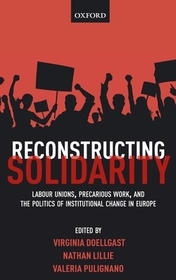
Reconstructing Solidarity
Labour Unions, Precarious Work, and the Politics of Institutional Change in Europe
- Publisher's listprice GBP 102.50
-
46 278 Ft (44 075 Ft + 5% VAT)
The price is estimated because at the time of ordering we do not know what conversion rates will apply to HUF / product currency when the book arrives. In case HUF is weaker, the price increases slightly, in case HUF is stronger, the price goes lower slightly.
- Discount 10% (cc. 4 628 Ft off)
- Discounted price 41 651 Ft (39 668 Ft + 5% VAT)
Subcribe now and take benefit of a favourable price.
Subscribe
46 278 Ft

Availability
printed on demand
Why don't you give exact delivery time?
Delivery time is estimated on our previous experiences. We give estimations only, because we order from outside Hungary, and the delivery time mainly depends on how quickly the publisher supplies the book. Faster or slower deliveries both happen, but we do our best to supply as quickly as possible.
Product details:
- Publisher OUP Oxford
- Date of Publication 18 January 2018
- ISBN 9780198791843
- Binding Hardback
- No. of pages270 pages
- Size 237x165x22 mm
- Weight 570 g
- Language English 0
Categories
Short description:
Reconstructing Solidarity explores the struggles of unions against the expansion of precarious work in Europe, and the implications of these struggles for worker solidarity and institutional change.
MoreLong description:
Work is widely thought to have become more precarious. Many people feel that unions represent the interests of protected workers in good jobs at the expense of workers with insecure employment, low pay, and less generous benefits. Reconstructing Solidarity: Labour Unions, Precarious Work, and the Politics of Institutional Change in Europe argues the opposite: that unions try to represent precarious workers using a variety of creative campaigning and organizing tactics.
Where unions can limit employers' ability to 'exit' labour market institutions and collective agreements, and build solidarity across different groups of workers, this results in a virtuous circle, establishing union control over the labour market. Where they fail to do so, it sets in motion a vicious circle of expanding precarity based on institutional evasion by employers. Reconstructing Solidarity examines how unions build, or fail to build, inclusive worker solidarity to challenge this vicious circle and to re-regulate increasingly precarious jobs. Comparative case studies from fourteen European countries describe the struggles of workers and unions in industries such as local government, retail, music, metalworking, chemicals, meat packing, and logistics. Their findings argue against the thesis that unions act primarily to protect labour market insiders at the expense of outsiders.
[Reconstructing Solidarity] is an important contribution to our understanding of trade union solidarity under institutional change in Europe. Its theoretical approach is one of its main strengths. On an interdisciplinary basis, the authors combine the comparative employment relations literature with that of comparative political economy and critical sociology.
Table of Contents:
From dualization to solidarity: Halting the cycle of precarity
Negotiating better conditions for workers during austerity in Europe: Unions' local strategies towards low pay and outsourcing in local government
Cutting to the bone: Workers' solidarity in the Danish-German slaughterhouse industry
Restructuring labour relations and employment in the European logistics sector: Unions' responses to a segmented workforce
Labour markets, solidarity and precarious work: Comparing local unions' responses to management flexibility strategies in the German and Belgian metalworking and chemical industries
The political economy of agency work in Italy and Germany: Explaining diverging trajectories in collective bargaining outcomes
Union campaigns against precarious work in the retail sector of Estonia, Poland, and Slovenia
Better strategies for herding cats? Forms of solidarity among freelance musicians in London, Paris and Ljubljana
Fighting precariousness: Union strategies towards migrant workers in the UK, France, and Germany
Unions and Migrant Workers: The Perspective of Estonians in Finland and Albanians in Italy and Greece
Conclusions. The Puzzle of Precarity: Structure, Strategies, and Worker Solidarity

