

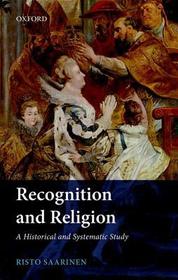
Recognition and Religion
A Historical and Systematic Study
- Publisher's listprice GBP 99.00
-
44 698 Ft (42 570 Ft + 5% VAT)
The price is estimated because at the time of ordering we do not know what conversion rates will apply to HUF / product currency when the book arrives. In case HUF is weaker, the price increases slightly, in case HUF is stronger, the price goes lower slightly.
- Discount 10% (cc. 4 470 Ft off)
- Discounted price 40 229 Ft (38 313 Ft + 5% VAT)
Subcribe now and take benefit of a favourable price.
Subscribe
44 698 Ft

Availability
printed on demand
Why don't you give exact delivery time?
Delivery time is estimated on our previous experiences. We give estimations only, because we order from outside Hungary, and the delivery time mainly depends on how quickly the publisher supplies the book. Faster or slower deliveries both happen, but we do our best to supply as quickly as possible.
Product details:
- Publisher OUP Oxford
- Date of Publication 27 October 2016
- ISBN 9780198791966
- Binding Hardback
- No. of pages282 pages
- Size 223x137x20 mm
- Weight 450 g
- Language English 0
Categories
Short description:
This work considers the intellectual history of religious recognition. The concept is usually thought to begin with Hegel but this work takes a much broader sweep, moving from the New Testament to the modern day connecting the history of religion with philosophical approaches.
MoreLong description:
During the last twenty years, the theory of recognition has become an established field of philosophy and social studies. Variants of this theory often promise applications to the burning political issues of current society, such as the challenges of multiculturalism, group identity, and conflicts between ideologies and religions. The seminal works of this trend employ Hegelian ideas to tackle the problem of modernity. Although some recent studies also investigate the pre-Hegelian roots of recognition, this concept is normally considered to be a product of the secular modernity of the nineteenth and twentieth centuries. Recognition and Religion: A Historical and Systematic Study challenges this assumption and claims that important intellectual roots of the concept and conceptions of recognition are found in much earlier religious sources.
Risto Saarinen outlines the first intellectual history of religious recognition, stretching from the New Testament to present day. He connects the history of religion with philosophical approaches, arguing that philosophers owe a considerable historical and conceptual debt to the religious processes of recognition. At the same time, religious recognition has a distinctive profile that differs from philosophy in some important respects. Saarinen undertakes a systematic elaboration of the insights provided by the tradition of religious recognition. He proposes that theology and philosophy can make creative use of the long history of religious recognition.
an exercise in analysis, discrimination and interpretation is called for and this is what Professor Risto Saarinen has provided in a very useful study, which has particular relevance to ecumenical theology and dialogue. He draws on recent work in the social sciences, the etymology of words for recognition in several languages, the history of the idea in philosophy and theology and on ecclesiological texts to provide a survey and analysis of both language use and theological thinking in this area. To take the language of recognition more seriously, with the help of this book, will guide our theology into a more personalist and relational mode.
Table of Contents:
List of Tables
List of Abbreviations
Introduction
1.1 The Task
1.2 Philosophical Theories of Recognition
1.3 Recognition in Current Theology
1.4 Concepts, Conceptions, and Paradigms
1.5 Parts of Recognition
The Latin Traditions
2.1 From the New Testament to the Latin Recognitions
2.2 Augustine on Agnitio and Recognitio
2.3 Attachment, Feudalism, and Bernard of Clairvaux
2.4 Thomas Aquinas and Later Scholastics
2.5 Marsilio Ficino: Loving Recognition
2.6 Martin Luther: Justification and Attachment
2.7 Calvin and Religious Knowledge
The Modern Era
3.1 From Hobbes to Pietism
3.2 Anerkennung in Religion: Fichte and Spalding
3.3 Hegel and Schleiermacher
3.4 Cultural Protestantism and Dialectical Theology
3.5 Legal Developments
3.6 Vatican II and the Ecumenical Movement
Recognition in Religion: A Systematic Outline
4.1 The Emergence of Historical Paradigms
4.2 The Nature of Religious Recognition
4.3 Gift and Language
4.4 Recognizing Oneself
4.5 Conclusion: Ways and Aims of Recognition
Sources and Literature
Index

