

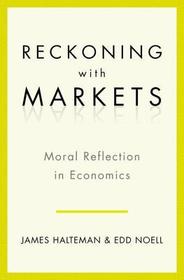
Reckoning With Markets
The Role of Moral Reflection in Economics
- Publisher's listprice GBP 52.00
-
23 478 Ft (22 360 Ft + 5% VAT)
The price is estimated because at the time of ordering we do not know what conversion rates will apply to HUF / product currency when the book arrives. In case HUF is weaker, the price increases slightly, in case HUF is stronger, the price goes lower slightly.
- Discount 10% (cc. 2 348 Ft off)
- Discounted price 21 130 Ft (20 124 Ft + 5% VAT)
Subcribe now and take benefit of a favourable price.
Subscribe
23 478 Ft

Availability
printed on demand
Why don't you give exact delivery time?
Delivery time is estimated on our previous experiences. We give estimations only, because we order from outside Hungary, and the delivery time mainly depends on how quickly the publisher supplies the book. Faster or slower deliveries both happen, but we do our best to supply as quickly as possible.
Product details:
- Publisher OUP USA
- Date of Publication 1 March 2012
- ISBN 9780199763702
- Binding Hardback
- No. of pages240 pages
- Size 211x145x20 mm
- Weight 376 g
- Language English
- Illustrations 3 illustrations 0
Categories
Short description:
This book presents the notion that economic thinking cannot escape value judgments at any level and that this understanding has been the dominant view throughout most of history. It shows how, from ancient times, people who thought about economic matters integrated moral reflection into their thinking.
MoreLong description:
Undergraduate economics students begin and end their study of economics with the simple claim that economics is value free. Only in a policy role will values and beliefs enter into economic work; there can be little meaningful dialogue by economists about such personal views and opinions. This view, now well over 200 years old, has been challenged by heterodox thinkers in economics, and philosophers and social scientists outside the discipline all along the way. However, much of the debate in modern times has been narrowly focused on philosophical methodological issues on one hand or theological/sectarian concerns on the other. None of this filters down to the typical undergraduate even in advanced courses of the history of economic thought.
This book presents the notion that economic thinking cannot escape value judgments at any level and that this understanding has been the dominant view throughout most of history. It shows how, from ancient times, people who thought about economic matters integrated moral reflection into their thinking. Reflecting on the Enlightenment and the birth of economics as a science, Halteman and Noell illustrate the process by which values and beliefs were excluded from economics proper. They also bring the reader up to date, given the changes over the last half-century.
With the advent of interdependency concepts and game theory, behavioral economics and the infusion of other social sciences, especially psychology, into economic considerations, the door is once again open to moral reflection. It is a sensitive subject that can be divisive for many and there is little if any assessable literature on the topic at the undergraduate level. One way to approach the subject is to follow the path of the great thinkers of the past and observe how they worked through economic issues from a set of values that was foundational to their thinking. This places moral thinking in a context illuminating the complexity and importance of moral reflection and illustrating its impact on the culture of the times. Reckoning With Markets follows this method with a deliberate effort to cast the material in terms that will engage the undergraduate student.
Halteman and Noell have written a timely book on the role of ethics, values, and value judgments in economic discourse ... This is an excellent book that will be useful to all economists who view economics as a moral science.
Table of Contents:
Preface
Chapter 1: Setting the Stage
Chapter 2: Moral Reflection in the Ancient Mediterranean World
Chapter 3: Virtue and Values in Scholastic Economic Thought
Chapter 4: Adam Smith and the Prospects for Moral Reflection in Enlightenment Thinking
Chapter 5: The Secularization of Political Economy
Chapter 6: Moral Reflection in Heterodox Economics
Chapter 7: On Methods and Morals
Chapter 8: Expanding and Reorienting the Scope of Economic Thinking
Chapter 9 Predicting, Explaining and Understanding: An Interdisciplinary Approach
Bibliography

