

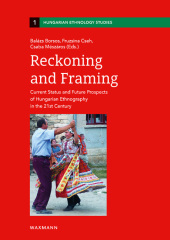
Reckoning and Framing
Current Status and Future Prospects of Hungarian Ethnography in the 21st Century
Series: Hungarian Ethnology Studies; 1;
- Publisher's listprice EUR 39.90
-
16 548 Ft (15 760 Ft + 5% VAT)
The price is estimated because at the time of ordering we do not know what conversion rates will apply to HUF / product currency when the book arrives. In case HUF is weaker, the price increases slightly, in case HUF is stronger, the price goes lower slightly.
16 548 Ft

Availability
Only to order.
Why don't you give exact delivery time?
Delivery time is estimated on our previous experiences. We give estimations only, because we order from outside Hungary, and the delivery time mainly depends on how quickly the publisher supplies the book. Faster or slower deliveries both happen, but we do our best to supply as quickly as possible.
Product details:
- Publisher Waxmann Verlag GmbH
- Date of Publication 1 January 2023
- ISBN 9783830946298
- Binding Paperback
- No. of pages366 pages
- Size 21x211x257 mm
- Weight 685 g
- Language English 354
Categories
Long description:
It is necessary for every discipline to take stock of its own current state every 20-30 years. Such review helps determine the discipline's path and tasks for the coming decades, and it also facilitates reflection upon the changes and challenges of the scientific and non-scientific world around it. For this purpose, the Committee of Ethnography of the Hungarian Academy of Sciences organized a series of conferences on the current state and the future of ethnography between 2018 and 2020. Those papers of international interest have been translated and are presented in this volume.
The first section discusses the dilemmas of ethnography/ethnology as an independent discipline. Articles in the second section provide a fresh perspective on the intrinsic interrelatedness of agriculture, livelihood, environmental perception, and traditional ecological knowledge studied by Hungarian ethnographers. The subsequent section scrutinizes research into and management of cultural heritage in Hungary and the role of ethnographic scholarship in safeguarding intangible heritage. The volume closes with insightful case studies on when ethnographic situations/experiences can be translated into meaningful social actions.
Insgesamt ein Buch, das interessante Einlbicke in das Fachverständnis und seine Themen in der Gegenwart in Ungarn einem der ungarischen Sprache nicht mächtigen lespulbikum ermöglicht. Als Auftaktband für eine neue Reihe ein gelungenes Beispiel. Paula Küng-Hefti, in: Schweizerischen Archivs für Volkskunde SAVk, 120/1 (2024), S. 123-125

