

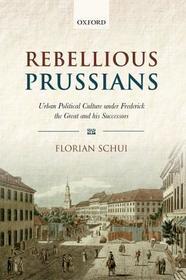
Rebellious Prussians
Urban Political Culture under Frederick the Great and his Successors
- Publisher's listprice GBP 140.00
-
63 210 Ft (60 200 Ft + 5% VAT)
The price is estimated because at the time of ordering we do not know what conversion rates will apply to HUF / product currency when the book arrives. In case HUF is weaker, the price increases slightly, in case HUF is stronger, the price goes lower slightly.
- Discount 10% (cc. 6 321 Ft off)
- Discounted price 56 889 Ft (54 180 Ft + 5% VAT)
Subcribe now and take benefit of a favourable price.
Subscribe
63 210 Ft

Availability
printed on demand
Why don't you give exact delivery time?
Delivery time is estimated on our previous experiences. We give estimations only, because we order from outside Hungary, and the delivery time mainly depends on how quickly the publisher supplies the book. Faster or slower deliveries both happen, but we do our best to supply as quickly as possible.
Product details:
- Publisher OUP Oxford
- Date of Publication 14 March 2013
- ISBN 9780199593965
- Binding Hardback
- No. of pages236 pages
- Size 241x162x19 mm
- Weight 516 g
- Language English
- Illustrations One map and 5 black and white figures 0
Categories
Short description:
Challenges the accepted view that an oppressive Prussian state cast a shadow on the development of civil society and sheds light on a little-known historical reality in which weak Hohenzollern monarchs - and a still weaker Prussian bureaucracy - were confronted with prosperous, fearless, and argumentative Prussian burghers.
MoreLong description:
Prussian discipline is legendary. Central to debates about modern German history is the view that an oppressive Prussian state cast a shadow on the development of civil society. In particular, historians have seen the absence of a revolution in the eighteenth century as a symptom of a delayed and incomplete emancipation of the Prussian bourgeoisie. Prussia's urban dwellers have often been portrayed as poor relations of the self-reliant and assertive bourgeois of Western Europe and the Atlantic world. Economically backward and politically oppressed, they were allegedly in no position to challenge the iron grip of the state and question the authority of the Hohenzollern dynasty.
Drawing from extensive and original research, Florian Schui challenges the accepted view and argues that Prussians in the eighteenth century were much more willing to challenge the state than has been recognised. Schui explores several instances where urban Prussians successfully resisted government policies and forced Frederick the Great and his successors to give in to their demands. Rebellious Prussians thus sheds light on a little-known historical reality in which weak Hohenzollern monarchs - and a still weaker Prussian bureaucracy - were confronted with prosperous, fearless, argumentative, and occasionally violent Prussian burghers.
Such conflicts between state and citizens were by no means unique to Prussia. Rather the events in Prussia were, on many levels, connected to similar contemporary developments in other parts of Europe and North America. Florian Schui systematically explores these links and thus develops a new European and Atlantic perspective on Prussian history in the eighteenth century.
Schui has successfully shown that examining resistance to fiscal and religious policy, rather than simply the glamour of eighteenth-century political radicalism, can inform us about Prussian and European history on a deep, engaging and critical level.
Table of Contents:
Introduction
The paradoxes of state building
Urban navel gazing
Official perspectives on the towns
Taxation and its discontents
Religion and the state
A Prussian on liberty
Conclusion: 'Le Sonderweg est mort, vive le Sonderweg?'
Bibliography
Index

