

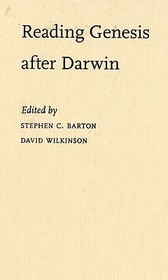
Reading Genesis after Darwin
- Publisher's listprice GBP 150.00
-
67 725 Ft (64 500 Ft + 5% VAT)
The price is estimated because at the time of ordering we do not know what conversion rates will apply to HUF / product currency when the book arrives. In case HUF is weaker, the price increases slightly, in case HUF is stronger, the price goes lower slightly.
- Discount 10% (cc. 6 773 Ft off)
- Discounted price 60 953 Ft (58 050 Ft + 5% VAT)
Subcribe now and take benefit of a favourable price.
Subscribe
67 725 Ft

Availability
printed on demand
Why don't you give exact delivery time?
Delivery time is estimated on our previous experiences. We give estimations only, because we order from outside Hungary, and the delivery time mainly depends on how quickly the publisher supplies the book. Faster or slower deliveries both happen, but we do our best to supply as quickly as possible.
Product details:
- Publisher OUP USA
- Date of Publication 19 November 2009
- ISBN 9780195383355
- Binding Hardback
- No. of pages272 pages
- Size 156x234x16 mm
- Weight 553 g
- Language English 0
Categories
Short description:
From creationism to The God Delusion, the public dialogue of science and religion either uses the early chapters of Genesis in a naïve and simplistic way or rejects their relevance to contemporary questions. This is reinforced by the myth that Darwin caused a rejection of a literalistic reading of Genesis 1 and from that point most Christian theology lost any confidence in these texts. The truth is far more complex. Jewish and Christian interpretation of the early chapters of Genesis had a long a fruitful history from the earliest times. As the distinguished authors of the papers in this volume show, far from Darwin burying these ancient texts, he has liberated them to speak in new and different ways.
MoreLong description:
From creationism to The God Delusion, the public dialogue of science and religion either uses the early chapters of Genesis in a naïve and simplistic way or rejects their relevance to contemporary questions. This is reinforced by the myth that Darwin caused a rejection of a literalistic reading of Genesis 1 and from that point most Christian theology lost any confidence in these texts. The truth is far more complex. Jewish and Christian interpretation of the early chapters of Genesis had a long a fruitful history from the earliest times. In the 19th century, many more important issues were at stake than biblical literalism, and there were many different interpretations of how the discoveries of Darwin helped or hindered the reading of the biblical text. Today, theologians are returning to the importance of Genesis as a partner in dialogue with science, gender, and environmental care. As the distinguished authors of the papers in this volume show, far from Darwin burying these ancient texts, he has liberated them to speak in new and different ways. The volume is divided into three parts. In the first, the authors explore how the scriptures themselves were interpreted before the time of Darwin. The fact that non-literal interpretations were standard in early Jewish and Christian thought is often ignored. In fact, these insightful early interpretations have much to teach us today. Part II presents essays on the real history of the Darwin controversies. Exploding the myths about this period, it is fascinating to see how Darwin was welcomed by many religious thinkers. In Part II, the authors apply the insights of Genesis post Darwin to contemporary issues today, such as: what it means to be human, questions of gender, and of evil and environmental care. The final chapter deals with the rise of creationism in its current social context.
It's a strange world when science can be used to dismiss the Bible, or when the Bible can be used to reject science - strange because God's people have long affirmed that the world and the Bible comprise God's Two Books. The challenge, then, is how to read the pages of both faithfully and to discern in their coordinated witness the character and aims of God. For its willingness to take up this challenge, and to do so accessibly and sensibly, Reading Genesis after Darwin is a genuinely important book. In their sketches of how Genesis was read before, during, and after the days of Darwin, these authors demonstrate how people might take the natural sciences seriously and continue to turn to Genesis 1-3 as sacred scripture.
Table of Contents:
Acknowledgements
Contributors
Introduction
Stephen C. Barton and David Wilkinson
Part 1: Engaging Again With The Scriptures
'How Should One Read The Early Chapters Of Genesis?'
Walter Moberly
'Genesis Before Darwin: Why Scripture Needed Liberating From Science'
Francis Watson
'The Six Days Of Creation According To The Greek Fathers'
Andrew Louth
. 'The Hermeneutics Of Reading Genesis After Darwin'
Richard S. Briggs
Part 2: Understanding The History
'What Difference Did Darwin Make? The Interpretation Of Genesis In The Nineteenth Century'
John Rogerson
. 'Genesis And The Scientists: Dissonance Among The Harmonizers'
John Hedley Brooke
. 'Science And Religion In Nineteenth And Twentieth Century Landscape Art'
David Brown
Exploring The Contemporary Relevance
'Reading Genesis 1-3 In The Light Of Modern Science'
David Wilkinson
. 'All God's Creatures: Reading Genesis On Human And Non-Human Animals'
David Clough
. 'Evolution And Evil: The Difference Darwin Makes In Theology And Spirituality'
Jeff Astley
'"Male And Female He Created Them" (Genesis 1:27): Interpreting Gender After Darwin'
Stephen C. Barton
'Propriety And Trespass: The Drama Of Eating'
Ellen F. Davis
. 'The Plausibility Of Creationism: A Sociological Comment'
Mathew Guest
Index of Modern Authors

