

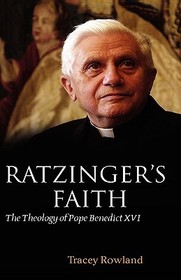
Ratzinger's Faith
The Theology of Pope Benedict XVI
- Publisher's listprice GBP 45.49
-
21 732 Ft (20 697 Ft + 5% VAT)
The price is estimated because at the time of ordering we do not know what conversion rates will apply to HUF / product currency when the book arrives. In case HUF is weaker, the price increases slightly, in case HUF is stronger, the price goes lower slightly.
- Discount 10% (cc. 2 173 Ft off)
- Discounted price 19 559 Ft (18 627 Ft + 5% VAT)
Subcribe now and take benefit of a favourable price.
Subscribe
21 732 Ft

Availability
printed on demand
Why don't you give exact delivery time?
Delivery time is estimated on our previous experiences. We give estimations only, because we order from outside Hungary, and the delivery time mainly depends on how quickly the publisher supplies the book. Faster or slower deliveries both happen, but we do our best to supply as quickly as possible.
Product details:
- Publisher OUP Oxford
- Date of Publication 6 March 2008
- ISBN 9780199207404
- Binding Hardback
- No. of pages220 pages
- Size 223x144x22 mm
- Weight 409 g
- Language English 0
Categories
Short description:
The first book to examine in detail the theological vision of Pope Benedict XVI. Rowland assesses his attitudes on moral theology, western culture, the liturgy and structure of the Catholic Church; she considers his interpretation of the Second Vatican Council, and his relations with other important scholars and theologians.
MoreLong description:
A general introduction to the theology of Pope Benedict XVI, including his approach to issues in moral and political theology, ecclesiology, liturgy, interpretations of the of the documents of the Second Vatican Council, and the theology of history. Tracey Rowland also addresses the question of Pope Benedict's place in the constellation of contemporary Catholic theologians. It has become a commonplace observation that Pope Benedict has been influenced by the thought of St Augustine, in contrast to many of his predecessors in the papacy who were much more strongly influenced by St Thomas Aquinas. Rowland therefore asks in what way Benedict is an Augustinian, and how this marked difference in theological perspective may play out in the coming years. Her book includes an extensive thematic bibliography, which will be valuable for students.
Benedict/Ratzinger has shown himself to be more conciliatory in his leadership than many had exoected. Tracey Rowland's study, written for readers who are not necessarily theologians, helps us understand why.
Table of Contents:
Foreword
Introduction
Ratzinger and Contemporary Theological Circles
'Gaudium et spes' and the Importance of Christ
Revelation, Scripture, and Tradition
Beyond Moralism: God is Love
The Structure of the Communion
Modernity and the Politics of the West
Liturgy since Vatican II
Conclusion

