

- Publisher's listprice GBP 23.99
-
10 831 Ft (10 315 Ft + 5% VAT)
The price is estimated because at the time of ordering we do not know what conversion rates will apply to HUF / product currency when the book arrives. In case HUF is weaker, the price increases slightly, in case HUF is stronger, the price goes lower slightly.
- Discount 10% (cc. 1 083 Ft off)
- Discounted price 9 748 Ft (9 284 Ft + 5% VAT)
Subcribe now and take benefit of a favourable price.
Subscribe
10 831 Ft

Availability
printed on demand
Why don't you give exact delivery time?
Delivery time is estimated on our previous experiences. We give estimations only, because we order from outside Hungary, and the delivery time mainly depends on how quickly the publisher supplies the book. Faster or slower deliveries both happen, but we do our best to supply as quickly as possible.
Product details:
- Publisher OUP USA
- Date of Publication 23 April 2025
- ISBN 9780197698877
- Binding Paperback
- No. of pages272 pages
- Size 201x119x22 mm
- Weight 272 g
- Language English 581
Categories
Short description:
Racial injustice, at its core, is the domination of time. The racially dominated are not free to define what counts as "progress," they are not free from the accumulation of past injustices, and, most importantly, they are not free from the arbitrary organization of work in capitalist labor markets. Utopia has been one response to this domination. William Paris here provides a theoretical account of utopia as the critical analysis of the sources of time domination, and the struggle to create emancipatory forms of life. He analyses the neglected "utopian" tradition of justice in black political thought that insists justice can only be secured through the transformation of society as a whole. Bringing into conversation the work of W.E.B Du Bois, Martin Delany, Marcus Garvey, Frantz Fanon, and James Boggs with the critical theory of Karl Marx, Ernst Bloch, Rahel Jaeggi, and Rainer Forst, Paris reconstructs a social theory and normative account of forms of life as the struggle over how time will be organized, asking "Can there be freedom without a new order of time?"
MoreLong description:
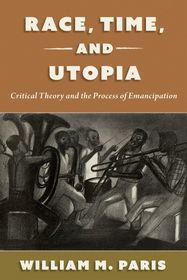
Racial injustice, at its core, is the domination of time. Utopia has been one response to this domination. The racially dominated are not free to define what counts as "progress," they are not free from the accumulation of past injustices, and, most importantly, they are not free from the arbitrary organization of work in capitalist labor markets. Racially unjust societies are forms of life where the justifications for how to organize time around life, labor, and leisure are out of the hands of the dominated. In Race, Time, and Utopia, William Paris provides a theoretical account of utopia as the critical analysis of the sources of time domination and the struggle to create emancipatory forms of life.
Rather than focusing on inclusion and equality before the law, as found in liberal theories of racial injustice, Paris analyses the neglected "utopian" tradition of justice in black political thought that insists justice can only be secured through the transformation of society as a whole. This transformation is nothing less than the democratic transformation of how organize and narrate our shared time. Bringing into conversation the work W.E.B Du Bois, Martin Delany, Marcus Garvey, Frantz Fanon, and James Boggs with the critical theory of Karl Marx, Ernst Bloch, Rahel Jaeggi, and Rainer Forst, Paris reconstructs a social theory and normative account of forms of life as the struggle over how time will be organized, asking "Can there be freedom without a new order of time?"
Race, Time, and Utopia: Critical Theory and the Process of Emancipation, philosopher William M. Paris makes an important contribution to several related conversations. Paris's book offers one of the richest and most well-grounded recent accounts of utopia, firmly centering the question of class struggle and his distinctive understanding of race. The book is an attempt to reconstruct and interrogate "utopian tendencies that have been immanent in historical processes of emancipation from racial domination." This is a multifaceted project that presents a new and exciting understanding of political and economic emancipation, drawing heavily on both the theorists of hope and utopia and the Black radical tradition generally.
Table of Contents:
Introduction
Chapter 1: Racial Justice and the Problem of Consciousness
Chapter 2: Race and the Fragmentation of Social Time: Critical Theory and the Utopian Hermeneutics of Souls
Chapter 3: Contesting the Polity: Black Nationalism, Utopia and the Reconstruction of Racial Life
Chapter 4: Racial Fetishism and the Alienation of Time: A Fanonian Critical Theory of Utopia
Chapter 5: Justifying Freedom: James Boggs and the Utopia of Black Power
Conclusion

