

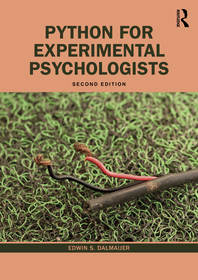
Python for Experimental Psychologists
A Fun Way of Learning How to Code Your Experiments and Analyses
-
GET 10% OFF
- Publisher's listprice GBP 38.99
-
18 627 Ft (17 740 Ft + 5% VAT)
The price is estimated because at the time of ordering we do not know what conversion rates will apply to HUF / product currency when the book arrives. In case HUF is weaker, the price increases slightly, in case HUF is stronger, the price goes lower slightly.
- Discount 10% (cc. 1 863 Ft off)
- Discounted price 16 764 Ft (15 966 Ft + 5% VAT)
16 764 Ft

Availability
Estimated delivery time: In stock at the publisher, but not at Prospero's office. Delivery time approx. 3-5 weeks.
Not in stock at Prospero.
Why don't you give exact delivery time?
Delivery time is estimated on our previous experiences. We give estimations only, because we order from outside Hungary, and the delivery time mainly depends on how quickly the publisher supplies the book. Faster or slower deliveries both happen, but we do our best to supply as quickly as possible.
Product details:
- Edition number 2
- Publisher Routledge
- Date of Publication 11 November 2024
- ISBN 9781032000459
- Binding Paperback
- No. of pages200 pages
- Size 246x174 mm
- Weight 370 g
- Language English
- Illustrations 20 Illustrations, black & white; 12 Halftones, black & white; 8 Line drawings, black & white 680
Categories
Short description:
Python for Experimental Psychologists equips researchers who have no prior programming experience with the essential knowledge to independently script experiments and analyses in the programming language Python. It offers an excellent introduction, whether you are an undergraduate, a PhD candidate or an established researcher.
MoreLong description:
Python for Experimental Psychologists equips researchers who have no prior programming experience with the essential knowledge to independently script experiments and analyses in the programming language Python. This book offers an excellent introduction, whether you are an undergraduate, a PhD candidate, or an established researcher.
This updated edition is on Python 3 (the most current version). It starts by teaching the fundamentals of programming in Python and then offers several chapters on scripting experiments (displaying stimuli, obtaining and logging user input, precision timing, etc.) using the popular PsychoPy package. The remainder of the book is dedicated to data analysis and includes chapters on reading/writing to text files, time series, eye tracking, data visualisation, and statistics.
Access to online support material enriches the learning experience with colour figures, example stimuli, datasets, scripts, and a portable Windows installation of Python. This book assumes no prior knowledge, and its informal and accessible tone helps readers with backgrounds in experimental psychology and cognitive neuroscience to quickly understand Python. It serves as a useful resource not only for researchers in these fields but also for lecturers instructing on methodology and data analysis.
Python for Experimental Psychologists demystifies programming complexities and empowers researchers to proficiently conduct experiments and analyse their results.
'Programming in Python is an invaluable skill for psychology researchers, for both making experiments and analysing the resulting data.'
Christopher R Madan, author of Memories That Matter: How We Remember Important Things, Academia and the World Beyond book series on post-PhD careers, and An Introduction to MATLAB for Behavioral Researchers
Praise for previous edition
'An easy-to-read introduction. In a humorous style it introduces the reader to programming in Python, picking them up where they are as experimental psychologists. Very useful indeed!'
Ulrich von Hecker, Senior Lecturer, Cardiff University, UK
'Edwin Dalmaijer provides an intuitive introduction into psychological experimentation using Python libraries co-developed by the author himself. Well-structured and easy to read, this book will quickly have you programming, running and analysing your own experiments using open, modern tools.'
Tomas Knapen, Assistant Professor Cognitive Neuroscience, Vrije Universiteit Amsterdam, The Netherlands
'Python is fast becoming the lingua franca of scientific research, and this excellent and highly accessible book fills a much-needed gap for experimental psychologists. The strong focus on developing genuinely useful experimental code, and the comprehensive examples included, make it an outstandingly useful resource not just for students, but for seasoned researchers as well. Certainly the best (and funniest!) introduction to Python I?ve come across.'
Matt Wall, Imaging Scientist, Imperial College London, UK
MoreTable of Contents:
About this book
About Python
About the authors
1. Python
2. Variable Types
Make Some Noise
Random Numbers
3. Creating and Presenting Stimuli
4. Processing Responses
Make Some Noise
5. Scripting An Experiment
Make Some Noise
6. Analysing Behavioural Data
7. Analysing Traces
8. Eye Tracking
9. Common Statistical Tests
Getting Help
Acknowledgements
References

