

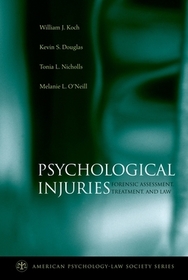
Psychological Injuries
Forensic Assessment, Treatment, and Law
Series: American Psychology-Law Society Series;
- Publisher's listprice GBP 66.00
-
29 799 Ft (28 380 Ft + 5% VAT)
The price is estimated because at the time of ordering we do not know what conversion rates will apply to HUF / product currency when the book arrives. In case HUF is weaker, the price increases slightly, in case HUF is stronger, the price goes lower slightly.
- Discount 10% (cc. 2 980 Ft off)
- Discounted price 26 819 Ft (25 542 Ft + 5% VAT)
Subcribe now and take benefit of a favourable price.
Subscribe
29 799 Ft

Availability
printed on demand
Why don't you give exact delivery time?
Delivery time is estimated on our previous experiences. We give estimations only, because we order from outside Hungary, and the delivery time mainly depends on how quickly the publisher supplies the book. Faster or slower deliveries both happen, but we do our best to supply as quickly as possible.
Product details:
- Publisher OUP USA
- Date of Publication 3 November 2005
- ISBN 9780195188288
- Binding Hardback
- No. of pages336 pages
- Size 160x234x27 mm
- Weight 601 g
- Language English
- Illustrations Tables and line drawings 0
Categories
Short description:
This volume describes the law related to, forensic assessment of, and treatment for psychological injuries, particularly posttraumatic stress disorder. Special attention is given to the empirical limits of forensic assessment of posttraumatic stress disorder, vulnerabilities in expert evidence, and empirically supported treatments.
MoreLong description:
Human emotional suffering has been studied for centuries, but the significance of psychological injuries within legal contexts has only recently been recognized. As the public becomes increasingly aware of the ways in which mental health affects physical - and financial - well-being, psychological injuries comprise a rapidly growing set of personal injury insurance claims. Although the diverse range of problems that people claim to suffer from are serious and often genuine, the largely subjective and unobservable nature of psychological conditions has led to much skepticism about the authenticity of psychological injury claims. Improved assessment methods and research on the economic and physical health consequences of psychological distress has resulted in exponential growth in the litigation related to such conditions.
Integrating the history of psychological injuries both from legal and mental health perspectives, this book offers compelling discussions of relevant statutory and case law. Focussing especially on posttraumatic stress disorder, it addresses the current status and empirical limitations of forensic assessments of psychological injuries and alerts readers to common vulnerabilities in expert evidence from mental health professionals. In addition, it also uses the latest empirical research to provide the best forensic methods for assessing both clinical conditions such as posttraumatic stress disorder and for alternative explanations such as malingering. The authors offer state-of-the-art information on early intervention, psychological therapies, and pharmaceutical treatments for posttraumatic stress disorder and stimulating suggestions for further research into this complex phenomenon.
A comprehensive guide to psychological injuries, this book will be an indispensable resource for all mental health practitioners, researchers, and legal professionals who work with psychological injuries.
Table of Contents:
Definition and History of the Concept of Psychological Injury
Legal Contexts and Law Related to Psychological Injuries
General Assessment Issues with Psychological Injuries
4. Detecting Exaggeration and Malingering in Psychological Injury Claims
Common Vulnerabilities in Psychological Evidence
Gender, Trauma and Distress
Ethnocultural Minorities
Prevention and Rehabilitation of Psychological Injuries
Psychological Injury Cases
Current Status and Future Trends
Index

