

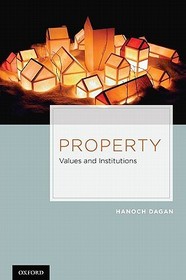
Property
Values and Institutions
- Publisher's listprice GBP 145.00
-
65 467 Ft (62 350 Ft + 5% VAT)
The price is estimated because at the time of ordering we do not know what conversion rates will apply to HUF / product currency when the book arrives. In case HUF is weaker, the price increases slightly, in case HUF is stronger, the price goes lower slightly.
- Discount 10% (cc. 6 547 Ft off)
- Discounted price 58 921 Ft (56 115 Ft + 5% VAT)
Subcribe now and take benefit of a favourable price.
Subscribe
65 467 Ft

Availability
printed on demand
Why don't you give exact delivery time?
Delivery time is estimated on our previous experiences. We give estimations only, because we order from outside Hungary, and the delivery time mainly depends on how quickly the publisher supplies the book. Faster or slower deliveries both happen, but we do our best to supply as quickly as possible.
Product details:
- Publisher OUP USA
- Date of Publication 17 March 2011
- ISBN 9780199737864
- Binding Hardback
- No. of pages352 pages
- Size 239x160x30 mm
- Weight 635 g
- Language English 0
Categories
Short description:
In Property: Values and Institutions, Hanoch Dagan covers numerous property issues to provide a liberal theory of property. The three parts in this book, Property, State, and Community are inter-connected. He analyzes the interactions between landowners and governments (both eminent domain and regulatory takings) and those regulating the governance of property owned by multiple individuals (such as co-ownership, marital property, and the law of common interest communities). He also places emphasis on groups and views property law from a broad institutional perspective to show that property law serves as the foundation for the organization of various types of groups and communities.
MoreLong description:
Property: Values and Institutions, by Hanoch Dagan, offers an original understanding of property, different from the dominant voices in the field, yet loyal to the practice of property. It rejects the misleading dominant binarism in which property is either one monistic form, structured around Blackstone's (in)famous formula of sole and despotic dominion, or a formless bundle of rights. Instead, it conceptualizes property as an umbrella for a set of institutions bearing a mutual family resemblance. It resists the prevailing tendency to discuss property through the prism of only one particular value, notably efficiency. Dagan argues that property can, and should, serve a pluralistic set of liberal values. These property values include not only autonomy and utility, which are emphasized by many contemporary scholars, but also labor, personhood, community, and distributive justice.
Dagan claims that property law, at least at its best, tailors different configurations of entitlements to different property institutions, with each such institution designed to match the specific balance between property values best suited to its characteristic social setting. Dagan develops this theoretical account and applies it to key doctrinal contexts. In particular, he analyzes the normative underpinnings of the doctrines regulating the interactions between landowners and governments (both eminent domain and regulatory takings doctrines) and those regulating the governance of property owned by multiple owners (such as co-ownership, marital property, and the law of common interest communities).
Table of Contents:
Prologue: Property and Realism
Part One: Property
1. The Craft of Property
2. Exclusion and Inclusion in Property
3. From Independence and Interdependence to the Pluralism of Property
4. Property and the Public Domain
Part Two: State
5. Takings and Distributive Justice
6. Just Compensation, Incentives, and Social Meanings
7. Re-Imagining Takings Law
Part Three: Community
8. The Liberal Commons
9. Properties of Marriage
10. Conflicts in Property

