

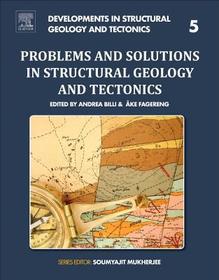
Problems and Solutions in Structural Geology and Tectonics
Series: Developments in Structural Geology and Tectonics; 5;
- Publisher's listprice EUR 132.00
-
51 559 Ft (49 104 Ft + 5% VAT)
The price is estimated because at the time of ordering we do not know what conversion rates will apply to HUF / product currency when the book arrives. In case HUF is weaker, the price increases slightly, in case HUF is stronger, the price goes lower slightly.
- Discount 20% (cc. 10 312 Ft off)
- Discounted price 41 247 Ft (39 283 Ft + 5% VAT)
- Discount is valid until: 30 June 2026
Subcribe now and take benefit of a favourable price.
Subscribe
51 559 Ft

Availability
printed on demand
Why don't you give exact delivery time?
Delivery time is estimated on our previous experiences. We give estimations only, because we order from outside Hungary, and the delivery time mainly depends on how quickly the publisher supplies the book. Faster or slower deliveries both happen, but we do our best to supply as quickly as possible.
Product details:
- Publisher Elsevier Science
- Date of Publication 6 March 2019
- ISBN 9780128140482
- Binding Paperback
- No. of pages316 pages
- Size 276x215 mm
- Weight 910 g
- Language English 0
Categories
Long description:
Problems and Solutions in Structural Geology and Tectonics, Volume 5, in the series Developments in Structural Geology and Tectonics, presents students, researchers and practitioners with an all-new set of problems and solutions that structural geologists and tectonics researchers commonly face. Topics covered include ductile deformation (such as strain analyses), brittle deformation (such as rock fracturing), brittle-ductile deformation, collisional and shortening tectonics, thrust-related exercises, rift and extensional tectonics, strike slip tectonics, and cross-section balancing exercises. The book provides a how-to guide for students of structural geology and geologists working in the oil, gas and mining industries.
MoreTable of Contents:
Integrating Observation and Interpretation to Understand Tectonics, Past and Present
1. Cross-section construction and balancing: examples from the Spanish Pyrenees
2. Techniques for describing the structural geology of cratonic fault and fold zones
3. Using geodesy data in structural geology
4. What do earthquake magnitudes mean? Example of the Kaikoura, New Zealand, 2016 event
Relating Observed Deformation to Stress and/or Strain History
5. Fluid pressure effects on deformation - Analysis of the Lusi Mud Volcano
6. Using Length/Throw ratio to assess the fitness of a fault framework interpretation
7. Pure Shear Kinematics
8. Strain Analysis
9. Unfolding veined fold limbs to deduce a basin's prefolding state of stress
Observations and Interpretations in Fieldwork and Hand Specimens
10. Recognition of structures in mid-crustal shear zones and how to discern between them
11. Early or late structures in thermogene travertines? Open-air lessons across Rome to focus on and answer this question
12. Characterizing Specimens from the Mid-Atlantic Appalachians in a Wilson Cycle Framework
13. Integrating Structural and Stratigraphic Field Data to Build a Tectonic Model for the Mid-Atlantic Appalachian Orogenic Cycle
Adding Modern Methods to Field Geology
14. From GoogleEarth to 3-D Geology Problem 1: Understanding structures and generating geological maps using GoogleEarth
15. From GoogleEarth to 3-D Geology Problem 2: Seeing below the surface of the Digital Earth
16. Structural interpretation of remote sensing images
Geophysical and Structural Techniques in Petroleum Geoscience and Borehole Projects
17. Understanding reservoir compartmentalization using Shale Gouge Ratio
18. How fault displacement patterns can be applied to investigate trap integrity
19. A numerical study of epithermal neutron log and application of image log
Novel Integration of Mathematical Methods, Computer Science, and Structural Geology
20. Boolean logic in Fluid Flow
21. Using Graph Theory to represent Fracture Networks
22. Synthesis of folds in 3D with Bezier surface

