

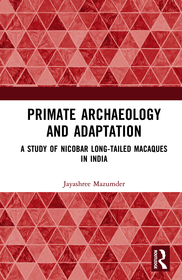
Primate Archaeology and Adaptation
A Study of Nicobar Long-Tailed Macaques in India
-
GET 10% OFF
- Publisher's listprice GBP 155.00
-
69 982 Ft (66 650 Ft + 5% VAT)
The price is estimated because at the time of ordering we do not know what conversion rates will apply to HUF / product currency when the book arrives. In case HUF is weaker, the price increases slightly, in case HUF is stronger, the price goes lower slightly.
- Discount 10% (cc. 6 998 Ft off)
- Discounted price 62 984 Ft (59 985 Ft + 5% VAT)
62 984 Ft

Availability
Not yet published.
Why don't you give exact delivery time?
Delivery time is estimated on our previous experiences. We give estimations only, because we order from outside Hungary, and the delivery time mainly depends on how quickly the publisher supplies the book. Faster or slower deliveries both happen, but we do our best to supply as quickly as possible.
Product details:
- Edition number 1
- Publisher Taylor & Francis
- Date of Publication 31 August 2026
- ISBN 9781041014010
- Binding Hardback
- No. of pages216 pages
- Size 229x152 mm
- Language English
- Illustrations 60 Illustrations, black & white 700
Categories
Short description:
Primate Archaeology and Adaptation offers an interdisciplinary examination of Nicobar long-tailed macaques, situating their tool use, social behavior, and ecological flexibility within deep evolutionary time and contemporary conservation challenges.
MoreLong description:
Primate Archaeology and Adaptation offers an interdisciplinary examination of Nicobar long-tailed macaques, situating their tool use, social behavior, and ecological flexibility within deep evolutionary time and contemporary conservation challenges. It documents the ecology, social organization, and behavioral repertoire of long-tailed macaques, including foraging strategies, food sharing, reproductive dynamics, exploratory behavior, and diverse forms of object manipulation. The book presents detailed accounts of tool-related behaviors, such as leaf 'glove' use, substrate selection for pounding, and the innovative use of anthropogenic materials, while carefully distinguishing between tool use and broader object use. By bridging fossil history, behavioral ecology, and archaeological method, it rethinks material culture beyond humans.
This book will interest scholars and advanced students in biological anthropology, primatology, archaeology, human evolution, animal behavior, and conservation studies. It will also appeal to researchers working on material culture, island ecology, and South Asian environmental policy.
MoreTable of Contents:
Chapter 1: Primate Archaeology across India and Abroad
Chapter 2: Knowing the Islands and the Animal
Chapter 3: Food and Foraging Behavior of Nicobar Long-Tailed Macaques
Chapter 4: Social Behavior, Exploration, and Context-dependent Behavioral Responses in Long-tailed Macaques
Chapter 5: Macaque Social and Reproductive Behavior
Chapter 6: Tool-use and Culture, Discovering Newness and Local Vibes: Lasting Traits and Vanished Details
Chapter 7: Conservation and the Future of Tool-Use Behavior and Cultural Heritage in Nicobar Macaques
More
