

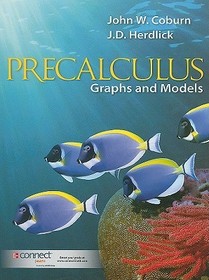
Precalculus: Graphs & Models
- Publisher's listprice GBP 151.99
-
68 623 Ft (65 355 Ft + 5% VAT)
The price is estimated because at the time of ordering we do not know what conversion rates will apply to HUF / product currency when the book arrives. In case HUF is weaker, the price increases slightly, in case HUF is stronger, the price goes lower slightly.
- Discount 10% (cc. 6 862 Ft off)
- Discounted price 61 760 Ft (58 820 Ft + 5% VAT)
Subcribe now and take benefit of a favourable price.
Subscribe
68 623 Ft

Availability
Out of print
Why don't you give exact delivery time?
Delivery time is estimated on our previous experiences. We give estimations only, because we order from outside Hungary, and the delivery time mainly depends on how quickly the publisher supplies the book. Faster or slower deliveries both happen, but we do our best to supply as quickly as possible.
Product details:
- Publisher McGraw-Hill Education
- Date of Publication 16 April 2011
- ISBN 9780073519531
- Binding Hardback
- No. of pages1248 pages
- Size 281x223x50 mm
- Weight 3105 g
- Language English 0
Categories
Long description:
Three components contribute to a theme sustained throughout the Coburn/Herdlick Graphs and Models series: that of laying a firm foundation, building a solid framework, and providing strong connections. In the Graphs and Models texts, the authors combine their depth of experience with the conversational style and the wealth of applications that the Coburn/Herdlick texts have become known for. By combining a graphical approach to problem solving with algebraic methods, students learn how to relate their mathematical knowledge to the outside world. The authors use technology to solve the more true to life equations, to engage more applications, and to explore the more substantial questions involving graphical behavior. Benefiting from the feedback of hundreds of instructors and students across the country, Precalculus: Graphs & Models emphasizes connections in order to improve the level of student engagement in mathematics and increase their chances of success in precalculus and calculus.
The launch of the Coburn/Herdlick Graphs and Models series provides a significant leap forward in terms of online course management with McGraw-Hill?s new homework platform, Connect Math Hosted by ALEKS Corp. Math instructors served as digital contributors to choose the problems that will be available, authoring each algorithm and providing stepped out solutions that go into great detail and are focused on areas where students commonly make mistakes. From there, the ALEKS Corporation reviewed each algorithm to ensure accuracy. A unifying theme throughout the entire process was the involvement of the authors. Through each step, they provided feedback and guidance to the digital contributors to ensure that the content being developed digitally closely matched the textbook. The result is an online homework platform that provides superior content and feedback, allowing students to effectively learn the material being taught.
Three components contribute to a theme sustained throughout the Coburn/Herdlick Graphs and Models series: that of laying a firm foundation, building a solid framework, and providing strong connections. In the Graphs and Models texts, the authors combine their depth of experience with the conversational style and the wealth of applications that the Coburn/Herdlick texts have become known for. By combining a graphical approach to problem solving with algebraic methods, students learn how to relate their mathematical knowledge to the outside world. The authors use technology to solve the more true to life equations, to engage more applications, and to explore the more substantial questions involving graphical behavior. Benefiting from the feedback of hundreds of instructors and students across the country, Precalculus: Graphs & Models emphasizes connections in order to improve the level of student engagement in mathematics and increase their chances of success in precalculus and calculus.
The launch of the Coburn/Herdlick Graphs and Models series provides a significant leap forward in terms of online course management with McGraw-Hill?s new homework platform, Connect Math Hosted by ALEKS Corp. Math instructors served as digital contributors to choose the problems that will be available, authoring each algorithm and providing stepped out solutions that go into great detail and are focused on areas where students commonly make mistakes. From there, the ALEKS Corporation reviewed each algorithm to ensure accuracy. A unifying theme throughout the entire process was the involvement of the authors. Through each step, they provided feedback and guidance to the digital contributors to ensure that the content being developed digitally closely matched the textbook. The result is an online homework platform that provides superior content and feedback, allowing students to effectively learn the material being taught.
Table of Contents:
Precalculus: Graphs & Models
Chapter 1: Functions and Graphs 1.1, Rectangular Coordinates; Graphing Circles and Other Relations 1.2, Linear Equations and Rates of Change 1.3, Functions, Function Notation, and the Graph of a Function 1.4, Linear Functions, Special Forms, and More on Rates of Change 1.5, Solving Equations and Inequalities Graphically; Formulas and Problem Solving 1.6, Linear Function Models and Real Data
Chapter 2: Relations, More on Functions 2.1, Analyzing the Graph of a Function2.2, The Toolbox Functions and Transformations 2.3, Absolute Value Functions, Equations, and Inequalities2.4, Rational and Radical Functions; More on the Domain2.5, Piecewise
-Defined Functions2.6, Variation: The Toolbox Functions in Action
Chapter 3: Quadratic Functions and Operations on Functions 3.1, Complex Numbers 3.2, Solving Quadratic Equations and Inequalities 3.3, Quadratic Functions and Applications 3.4, Quadratic Models; More on Rates of Change 3.5, The Algebra of Functions 3.6, Composition of Functions and the Difference Quotient
Chapter 4: Polynomial and Rational Functions 4.1, Synthetic Division; the Remainder and Factor Theorems 4.2, The Zeros of Polynomial Functions 4.3, Graphing Polynomial Functions 4.4, Graphing Rational Functions 4.5, Additional Insights into Rational Functions 4.6, Polynomial and Rational Inequalities
Chapter 5: Exponential and Logarithmic Functions 5.1, One
-to
-One and Inverse Functions 5.2, Exponential Functions 5.3, Logarithms and Logarithmic Functions 5.4, Properties of Logarithms 5.5, Solving Exponential and Logarithmic Equations 5.6, Applications from Business, Finance, and Science 5.7, Exponential, Logarithmic, and Logistic Equation Models
Chapter 6: Introduction to Trigonometry 6.1, Angle Measure, Special Triangles, and Special Angles 6.2, Unit Circles and the Trigonometry of Real Numbers 6.3, Graphs of Sine and Cosine Functions 6.4, Graphs of the Cosecant, Secant, Tangent, and Cotangent Functions 6.5, Transformations and Applications of Trigonometric Graphs 6.6, The Trigonometry of Right Triangles 6.7, Trigonometry and the Coordinate Plane 6.8, Trigonometric Equation Models
Chapter 7: Trigonometric Identities, Inverses, and Equations 7.1, Fundamental Identities and Families of Identities 7.2, More on Verifying Identities 7.3, The Sum and Difference Identities 7.4, The Double
-Angle, Half
-Angle and Product
-to
-Sum Identities 7.5, The Inverse Trigonometric Functions and their Applications 7.6, Solving Basic Trig Equations 7.7, General Trig Equations and Applications
Chapter 8: Applications of Trigonometry 8.1, Oblique Triangles and the Law of Sines 8.2, The Law of Cosines; the Area of a Triangle 8.3, Vectors and Vector Diagrams 8.4, Vector Applications and the Dot Product 8.5, Complex Numbers in Trigonometric Form 8.6, De Moivre?s Theorem and the Theorem on nth Roots
Chapter 9: Systems of Equations ad Inequalities; Matrices 9.1, Linear Systems in Two Variables with Applications 9.2, Linear Systems in Three Variables with Applications 9.3, Systems of Inequalities and Linear Programming 9.4, Partial Fraction Decomposition 9.5, Solving Linear Systems Using Matrices and Row Operations 9.6, The Algebra of Matrices 9.7, Solving Linear Systems Using Matrix Equations 9.8, Applications of Matrices and Determinants: Cramer?s Rule, Geometry, and More
Chapter 10: Analytical Geometry and the Conic Sections 10.1, A Brief Introduction to Analytic Geometry 10.2, The Circle and the Ellipse 10.3, The Hyperbola 10.4, The Analytic Parabola 10.5, Nonlinear Systems of Equations and Inequalities 10.6, Polar Coordinates, Equations, and Graphs 10.7, More on the Conic Sections: Rotation of Axes and Polar Form 10.8, Parametric Equations and Graphs
Chapter 11: Additional Topics in Algebra 11.1, Sequences and Series 11.2, Arithmetic Sequences 11.3, Geometric Sequences 11.4, Mathematical Induction 11.5, Counting Techniques 11.6, Introduction to Probability 11.7, The Binomial Theorem
Chapter 12: Bridges to Calculus ? An Introduction to Limits 12.1, An Introduction to Limits Using Tables and Graphs 12.2, The Properties of Limits 12.3, Continuity and More on Limits 12.4, Applications of Limits: Instantaneous Rates of Change and the Area Under a Curve
Appendix A: A Review of Basic Concepts and Skills A.1, Algebraic Expressions and the Properties of Real Numbers A.2, Exponents, Scientific Notation, and a Review of Polynomials A.3, Solving Linear Equations and Inequalities A.4, Factoring Polynomials and Solving Equations by Factoring A.5, Rational Expressions and Equations A.6, Radicals, Rational Exponents, and Radical Equations
Appendix B: Proof Positive
- A Selection of Proofs from Precalculus Appendix C: More on Synthetic Division Appendix D: Reduced Row
-Echelon Form and More on Matrices Appendix E: The Equation of a Conic Appendix F: Families of Polar Curves Online Appendices AO.1, The Language, Notation, and Numbers of Mathematics AO.2, Geometry Review with Unit Conversions
More
1.1, Rectangular Coordinates; Graphing Circles and Other Relations
1.2, Linear Equations and Rates of Change
1.3, Functions, Function Notation, and the Graph of a Function
1.4, Linear Functions, Special Forms, and More on Rates of Change
1.5, Solving Equations and Inequalities Graphically; Formulas and Problem Solving
1.6, Linear Function Models and Real Data
Chapter 2: Relations, More on Functions 2.1, Analyzing the Graph of a Function2.2, The Toolbox Functions and Transformations 2.3, Absolute Value Functions, Equations, and Inequalities2.4, Rational and Radical Functions; More on the Domain2.5, Piecewise
-Defined Functions2.6, Variation: The Toolbox Functions in Action
Chapter 3: Quadratic Functions and Operations on Functions 3.1, Complex Numbers 3.2, Solving Quadratic Equations and Inequalities 3.3, Quadratic Functions and Applications 3.4, Quadratic Models; More on Rates of Change 3.5, The Algebra of Functions 3.6, Composition of Functions and the Difference Quotient
Chapter 4: Polynomial and Rational Functions 4.1, Synthetic Division; the Remainder and Factor Theorems 4.2, The Zeros of Polynomial Functions 4.3, Graphing Polynomial Functions 4.4, Graphing Rational Functions 4.5, Additional Insights into Rational Functions 4.6, Polynomial and Rational Inequalities
Chapter 5: Exponential and Logarithmic Functions 5.1, One
-to
-One and Inverse Functions 5.2, Exponential Functions 5.3, Logarithms and Logarithmic Functions 5.4, Properties of Logarithms 5.5, Solving Exponential and Logarithmic Equations 5.6, Applications from Business, Finance, and Science 5.7, Exponential, Logarithmic, and Logistic Equation Models
Chapter 6: Introduction to Trigonometry 6.1, Angle Measure, Special Triangles, and Special Angles 6.2, Unit Circles and the Trigonometry of Real Numbers 6.3, Graphs of Sine and Cosine Functions 6.4, Graphs of the Cosecant, Secant, Tangent, and Cotangent Functions 6.5, Transformations and Applications of Trigonometric Graphs 6.6, The Trigonometry of Right Triangles 6.7, Trigonometry and the Coordinate Plane 6.8, Trigonometric Equation Models
Chapter 7: Trigonometric Identities, Inverses, and Equations 7.1, Fundamental Identities and Families of Identities 7.2, More on Verifying Identities 7.3, The Sum and Difference Identities 7.4, The Double
-Angle, Half
-Angle and Product
-to
-Sum Identities 7.5, The Inverse Trigonometric Functions and their Applications 7.6, Solving Basic Trig Equations 7.7, General Trig Equations and Applications
Chapter 8: Applications of Trigonometry 8.1, Oblique Triangles and the Law of Sines 8.2, The Law of Cosines; the Area of a Triangle 8.3, Vectors and Vector Diagrams 8.4, Vector Applications and the Dot Product 8.5, Complex Numbers in Trigonometric Form 8.6, De Moivre?s Theorem and the Theorem on nth Roots
Chapter 9: Systems of Equations ad Inequalities; Matrices 9.1, Linear Systems in Two Variables with Applications 9.2, Linear Systems in Three Variables with Applications 9.3, Systems of Inequalities and Linear Programming 9.4, Partial Fraction Decomposition 9.5, Solving Linear Systems Using Matrices and Row Operations 9.6, The Algebra of Matrices 9.7, Solving Linear Systems Using Matrix Equations 9.8, Applications of Matrices and Determinants: Cramer?s Rule, Geometry, and More
Chapter 10: Analytical Geometry and the Conic Sections 10.1, A Brief Introduction to Analytic Geometry 10.2, The Circle and the Ellipse 10.3, The Hyperbola 10.4, The Analytic Parabola 10.5, Nonlinear Systems of Equations and Inequalities 10.6, Polar Coordinates, Equations, and Graphs 10.7, More on the Conic Sections: Rotation of Axes and Polar Form 10.8, Parametric Equations and Graphs
Chapter 11: Additional Topics in Algebra 11.1, Sequences and Series 11.2, Arithmetic Sequences 11.3, Geometric Sequences 11.4, Mathematical Induction 11.5, Counting Techniques 11.6, Introduction to Probability 11.7, The Binomial Theorem
Chapter 12: Bridges to Calculus ? An Introduction to Limits 12.1, An Introduction to Limits Using Tables and Graphs 12.2, The Properties of Limits 12.3, Continuity and More on Limits 12.4, Applications of Limits: Instantaneous Rates of Change and the Area Under a Curve
Appendix A: A Review of Basic Concepts and Skills A.1, Algebraic Expressions and the Properties of Real Numbers A.2, Exponents, Scientific Notation, and a Review of Polynomials A.3, Solving Linear Equations and Inequalities A.4, Factoring Polynomials and Solving Equations by Factoring A.5, Rational Expressions and Equations A.6, Radicals, Rational Exponents, and Radical Equations
Appendix B: Proof Positive
- A Selection of Proofs from Precalculus Appendix C: More on Synthetic Division Appendix D: Reduced Row
-Echelon Form and More on Matrices Appendix E: The Equation of a Conic Appendix F: Families of Polar Curves Online Appendices AO.1, The Language, Notation, and Numbers of Mathematics AO.2, Geometry Review with Unit Conversions
More
2.1, Analyzing the Graph of a Function2.2, The Toolbox Functions and Transformations 2.3, Absolute Value Functions, Equations, and Inequalities2.4, Rational and Radical Functions; More on the Domain2.5, Piecewise
-Defined Functions2.6, Variation: The Toolbox Functions in Action
2.3, Absolute Value Functions, Equations, and Inequalities2.4, Rational and Radical Functions; More on the Domain2.5, Piecewise
-Defined Functions2.6, Variation: The Toolbox Functions in Action
2.5, Piecewise
-Defined Functions2.6, Variation: The Toolbox Functions in Action
3.1, Complex Numbers
3.2, Solving Quadratic Equations and Inequalities
3.3, Quadratic Functions and Applications
3.4, Quadratic Models; More on Rates of Change
3.5, The Algebra of Functions
3.6, Composition of Functions and the Difference Quotient
Chapter 4: Polynomial and Rational Functions 4.1, Synthetic Division; the Remainder and Factor Theorems 4.2, The Zeros of Polynomial Functions 4.3, Graphing Polynomial Functions 4.4, Graphing Rational Functions 4.5, Additional Insights into Rational Functions 4.6, Polynomial and Rational Inequalities
Chapter 5: Exponential and Logarithmic Functions 5.1, One
-to
-One and Inverse Functions 5.2, Exponential Functions 5.3, Logarithms and Logarithmic Functions 5.4, Properties of Logarithms 5.5, Solving Exponential and Logarithmic Equations 5.6, Applications from Business, Finance, and Science 5.7, Exponential, Logarithmic, and Logistic Equation Models
Chapter 6: Introduction to Trigonometry 6.1, Angle Measure, Special Triangles, and Special Angles 6.2, Unit Circles and the Trigonometry of Real Numbers 6.3, Graphs of Sine and Cosine Functions 6.4, Graphs of the Cosecant, Secant, Tangent, and Cotangent Functions 6.5, Transformations and Applications of Trigonometric Graphs 6.6, The Trigonometry of Right Triangles 6.7, Trigonometry and the Coordinate Plane 6.8, Trigonometric Equation Models
Chapter 7: Trigonometric Identities, Inverses, and Equations 7.1, Fundamental Identities and Families of Identities 7.2, More on Verifying Identities 7.3, The Sum and Difference Identities 7.4, The Double
-Angle, Half
-Angle and Product
-to
-Sum Identities 7.5, The Inverse Trigonometric Functions and their Applications 7.6, Solving Basic Trig Equations 7.7, General Trig Equations and Applications
Chapter 8: Applications of Trigonometry 8.1, Oblique Triangles and the Law of Sines 8.2, The Law of Cosines; the Area of a Triangle 8.3, Vectors and Vector Diagrams 8.4, Vector Applications and the Dot Product 8.5, Complex Numbers in Trigonometric Form 8.6, De Moivre?s Theorem and the Theorem on nth Roots
Chapter 9: Systems of Equations ad Inequalities; Matrices 9.1, Linear Systems in Two Variables with Applications 9.2, Linear Systems in Three Variables with Applications 9.3, Systems of Inequalities and Linear Programming 9.4, Partial Fraction Decomposition 9.5, Solving Linear Systems Using Matrices and Row Operations 9.6, The Algebra of Matrices 9.7, Solving Linear Systems Using Matrix Equations 9.8, Applications of Matrices and Determinants: Cramer?s Rule, Geometry, and More
Chapter 10: Analytical Geometry and the Conic Sections 10.1, A Brief Introduction to Analytic Geometry 10.2, The Circle and the Ellipse 10.3, The Hyperbola 10.4, The Analytic Parabola 10.5, Nonlinear Systems of Equations and Inequalities 10.6, Polar Coordinates, Equations, and Graphs 10.7, More on the Conic Sections: Rotation of Axes and Polar Form 10.8, Parametric Equations and Graphs
Chapter 11: Additional Topics in Algebra 11.1, Sequences and Series 11.2, Arithmetic Sequences 11.3, Geometric Sequences 11.4, Mathematical Induction 11.5, Counting Techniques 11.6, Introduction to Probability 11.7, The Binomial Theorem
Chapter 12: Bridges to Calculus ? An Introduction to Limits 12.1, An Introduction to Limits Using Tables and Graphs 12.2, The Properties of Limits 12.3, Continuity and More on Limits 12.4, Applications of Limits: Instantaneous Rates of Change and the Area Under a Curve
Appendix A: A Review of Basic Concepts and Skills A.1, Algebraic Expressions and the Properties of Real Numbers A.2, Exponents, Scientific Notation, and a Review of Polynomials A.3, Solving Linear Equations and Inequalities A.4, Factoring Polynomials and Solving Equations by Factoring A.5, Rational Expressions and Equations A.6, Radicals, Rational Exponents, and Radical Equations
Appendix B: Proof Positive
- A Selection of Proofs from Precalculus Appendix C: More on Synthetic Division Appendix D: Reduced Row
-Echelon Form and More on Matrices Appendix E: The Equation of a Conic Appendix F: Families of Polar Curves Online Appendices AO.1, The Language, Notation, and Numbers of Mathematics AO.2, Geometry Review with Unit Conversions
More
4.1, Synthetic Division; the Remainder and Factor Theorems 4.2, The Zeros of Polynomial Functions 4.3, Graphing Polynomial Functions 4.4, Graphing Rational Functions 4.5, Additional Insights into Rational Functions 4.6, Polynomial and Rational Inequalities
4.3, Graphing Polynomial Functions 4.4, Graphing Rational Functions 4.5, Additional Insights into Rational Functions 4.6, Polynomial and Rational Inequalities
4.5, Additional Insights into Rational Functions 4.6, Polynomial and Rational Inequalities
5.1, One
-to
-One and Inverse Functions5.2, Exponential Functions
5.3, Logarithms and Logarithmic Functions
5.4, Properties of Logarithms
5.5, Solving Exponential and Logarithmic Equations
5.6, Applications from Business, Finance, and Science
5.7, Exponential, Logarithmic, and Logistic Equation Models
Chapter 6: Introduction to Trigonometry 6.1, Angle Measure, Special Triangles, and Special Angles 6.2, Unit Circles and the Trigonometry of Real Numbers 6.3, Graphs of Sine and Cosine Functions 6.4, Graphs of the Cosecant, Secant, Tangent, and Cotangent Functions 6.5, Transformations and Applications of Trigonometric Graphs 6.6, The Trigonometry of Right Triangles 6.7, Trigonometry and the Coordinate Plane 6.8, Trigonometric Equation Models
Chapter 7: Trigonometric Identities, Inverses, and Equations 7.1, Fundamental Identities and Families of Identities 7.2, More on Verifying Identities 7.3, The Sum and Difference Identities 7.4, The Double
-Angle, Half
-Angle and Product
-to
-Sum Identities 7.5, The Inverse Trigonometric Functions and their Applications 7.6, Solving Basic Trig Equations 7.7, General Trig Equations and Applications
Chapter 8: Applications of Trigonometry 8.1, Oblique Triangles and the Law of Sines 8.2, The Law of Cosines; the Area of a Triangle 8.3, Vectors and Vector Diagrams 8.4, Vector Applications and the Dot Product 8.5, Complex Numbers in Trigonometric Form 8.6, De Moivre?s Theorem and the Theorem on nth Roots
Chapter 9: Systems of Equations ad Inequalities; Matrices 9.1, Linear Systems in Two Variables with Applications 9.2, Linear Systems in Three Variables with Applications 9.3, Systems of Inequalities and Linear Programming 9.4, Partial Fraction Decomposition 9.5, Solving Linear Systems Using Matrices and Row Operations 9.6, The Algebra of Matrices 9.7, Solving Linear Systems Using Matrix Equations 9.8, Applications of Matrices and Determinants: Cramer?s Rule, Geometry, and More
Chapter 10: Analytical Geometry and the Conic Sections 10.1, A Brief Introduction to Analytic Geometry 10.2, The Circle and the Ellipse 10.3, The Hyperbola 10.4, The Analytic Parabola 10.5, Nonlinear Systems of Equations and Inequalities 10.6, Polar Coordinates, Equations, and Graphs 10.7, More on the Conic Sections: Rotation of Axes and Polar Form 10.8, Parametric Equations and Graphs
Chapter 11: Additional Topics in Algebra 11.1, Sequences and Series 11.2, Arithmetic Sequences 11.3, Geometric Sequences 11.4, Mathematical Induction 11.5, Counting Techniques 11.6, Introduction to Probability 11.7, The Binomial Theorem
Chapter 12: Bridges to Calculus ? An Introduction to Limits 12.1, An Introduction to Limits Using Tables and Graphs 12.2, The Properties of Limits 12.3, Continuity and More on Limits 12.4, Applications of Limits: Instantaneous Rates of Change and the Area Under a Curve
Appendix A: A Review of Basic Concepts and Skills A.1, Algebraic Expressions and the Properties of Real Numbers A.2, Exponents, Scientific Notation, and a Review of Polynomials A.3, Solving Linear Equations and Inequalities A.4, Factoring Polynomials and Solving Equations by Factoring A.5, Rational Expressions and Equations A.6, Radicals, Rational Exponents, and Radical Equations
Appendix B: Proof Positive
- A Selection of Proofs from Precalculus Appendix C: More on Synthetic Division Appendix D: Reduced Row
-Echelon Form and More on Matrices Appendix E: The Equation of a Conic Appendix F: Families of Polar Curves Online Appendices AO.1, The Language, Notation, and Numbers of Mathematics AO.2, Geometry Review with Unit Conversions
More
6.1, Angle Measure, Special Triangles, and Special Angles 6.2, Unit Circles and the Trigonometry of Real Numbers 6.3, Graphs of Sine and Cosine Functions 6.4, Graphs of the Cosecant, Secant, Tangent, and Cotangent Functions 6.5, Transformations and Applications of Trigonometric Graphs 6.6, The Trigonometry of Right Triangles 6.7, Trigonometry and the Coordinate Plane 6.8, Trigonometric Equation Models
6.3, Graphs of Sine and Cosine Functions 6.4, Graphs of the Cosecant, Secant, Tangent, and Cotangent Functions 6.5, Transformations and Applications of Trigonometric Graphs 6.6, The Trigonometry of Right Triangles 6.7, Trigonometry and the Coordinate Plane 6.8, Trigonometric Equation Models
6.5, Transformations and Applications of Trigonometric Graphs 6.6, The Trigonometry of Right Triangles 6.7, Trigonometry and the Coordinate Plane 6.8, Trigonometric Equation Models
6.7, Trigonometry and the Coordinate Plane 6.8, Trigonometric Equation Models
7.1, Fundamental Identities and Families of Identities
7.2, More on Verifying Identities
7.3, The Sum and Difference Identities
7.4, The Double
-Angle, Half
-Angle and Product
-to
-Sum Identities7.5, The Inverse Trigonometric Functions and their Applications
7.6, Solving Basic Trig Equations
7.7, General Trig Equations and Applications
Chapter 8: Applications of Trigonometry 8.1, Oblique Triangles and the Law of Sines 8.2, The Law of Cosines; the Area of a Triangle 8.3, Vectors and Vector Diagrams 8.4, Vector Applications and the Dot Product 8.5, Complex Numbers in Trigonometric Form 8.6, De Moivre?s Theorem and the Theorem on nth Roots
Chapter 9: Systems of Equations ad Inequalities; Matrices 9.1, Linear Systems in Two Variables with Applications 9.2, Linear Systems in Three Variables with Applications 9.3, Systems of Inequalities and Linear Programming 9.4, Partial Fraction Decomposition 9.5, Solving Linear Systems Using Matrices and Row Operations 9.6, The Algebra of Matrices 9.7, Solving Linear Systems Using Matrix Equations 9.8, Applications of Matrices and Determinants: Cramer?s Rule, Geometry, and More
Chapter 10: Analytical Geometry and the Conic Sections 10.1, A Brief Introduction to Analytic Geometry 10.2, The Circle and the Ellipse 10.3, The Hyperbola 10.4, The Analytic Parabola 10.5, Nonlinear Systems of Equations and Inequalities 10.6, Polar Coordinates, Equations, and Graphs 10.7, More on the Conic Sections: Rotation of Axes and Polar Form 10.8, Parametric Equations and Graphs
Chapter 11: Additional Topics in Algebra 11.1, Sequences and Series 11.2, Arithmetic Sequences 11.3, Geometric Sequences 11.4, Mathematical Induction 11.5, Counting Techniques 11.6, Introduction to Probability 11.7, The Binomial Theorem
Chapter 12: Bridges to Calculus ? An Introduction to Limits 12.1, An Introduction to Limits Using Tables and Graphs 12.2, The Properties of Limits 12.3, Continuity and More on Limits 12.4, Applications of Limits: Instantaneous Rates of Change and the Area Under a Curve
Appendix A: A Review of Basic Concepts and Skills A.1, Algebraic Expressions and the Properties of Real Numbers A.2, Exponents, Scientific Notation, and a Review of Polynomials A.3, Solving Linear Equations and Inequalities A.4, Factoring Polynomials and Solving Equations by Factoring A.5, Rational Expressions and Equations A.6, Radicals, Rational Exponents, and Radical Equations
Appendix B: Proof Positive
- A Selection of Proofs from Precalculus Appendix C: More on Synthetic Division Appendix D: Reduced Row
-Echelon Form and More on Matrices Appendix E: The Equation of a Conic Appendix F: Families of Polar Curves Online Appendices AO.1, The Language, Notation, and Numbers of Mathematics AO.2, Geometry Review with Unit Conversions
More
8.1, Oblique Triangles and the Law of Sines 8.2, The Law of Cosines; the Area of a Triangle 8.3, Vectors and Vector Diagrams 8.4, Vector Applications and the Dot Product 8.5, Complex Numbers in Trigonometric Form 8.6, De Moivre?s Theorem and the Theorem on nth Roots
8.3, Vectors and Vector Diagrams 8.4, Vector Applications and the Dot Product 8.5, Complex Numbers in Trigonometric Form 8.6, De Moivre?s Theorem and the Theorem on nth Roots
8.5, Complex Numbers in Trigonometric Form 8.6, De Moivre?s Theorem and the Theorem on nth Roots
9.1, Linear Systems in Two Variables with Applications
9.2, Linear Systems in Three Variables with Applications
9.3, Systems of Inequalities and Linear Programming
9.4, Partial Fraction Decomposition
9.5, Solving Linear Systems Using Matrices and Row Operations
9.6, The Algebra of Matrices
9.7, Solving Linear Systems Using Matrix Equations
9.8, Applications of Matrices and Determinants: Cramer?s Rule, Geometry, and More
Chapter 10: Analytical Geometry and the Conic Sections 10.1, A Brief Introduction to Analytic Geometry 10.2, The Circle and the Ellipse 10.3, The Hyperbola 10.4, The Analytic Parabola 10.5, Nonlinear Systems of Equations and Inequalities 10.6, Polar Coordinates, Equations, and Graphs 10.7, More on the Conic Sections: Rotation of Axes and Polar Form 10.8, Parametric Equations and Graphs
Chapter 11: Additional Topics in Algebra 11.1, Sequences and Series 11.2, Arithmetic Sequences 11.3, Geometric Sequences 11.4, Mathematical Induction 11.5, Counting Techniques 11.6, Introduction to Probability 11.7, The Binomial Theorem
Chapter 12: Bridges to Calculus ? An Introduction to Limits 12.1, An Introduction to Limits Using Tables and Graphs 12.2, The Properties of Limits 12.3, Continuity and More on Limits 12.4, Applications of Limits: Instantaneous Rates of Change and the Area Under a Curve
Appendix A: A Review of Basic Concepts and Skills A.1, Algebraic Expressions and the Properties of Real Numbers A.2, Exponents, Scientific Notation, and a Review of Polynomials A.3, Solving Linear Equations and Inequalities A.4, Factoring Polynomials and Solving Equations by Factoring A.5, Rational Expressions and Equations A.6, Radicals, Rational Exponents, and Radical Equations
Appendix B: Proof Positive
- A Selection of Proofs from Precalculus Appendix C: More on Synthetic Division Appendix D: Reduced Row
-Echelon Form and More on Matrices Appendix E: The Equation of a Conic Appendix F: Families of Polar Curves Online Appendices AO.1, The Language, Notation, and Numbers of Mathematics AO.2, Geometry Review with Unit Conversions
More
10.1, A Brief Introduction to Analytic Geometry 10.2, The Circle and the Ellipse 10.3, The Hyperbola 10.4, The Analytic Parabola 10.5, Nonlinear Systems of Equations and Inequalities 10.6, Polar Coordinates, Equations, and Graphs 10.7, More on the Conic Sections: Rotation of Axes and Polar Form 10.8, Parametric Equations and Graphs
10.3, The Hyperbola 10.4, The Analytic Parabola 10.5, Nonlinear Systems of Equations and Inequalities 10.6, Polar Coordinates, Equations, and Graphs 10.7, More on the Conic Sections: Rotation of Axes and Polar Form 10.8, Parametric Equations and Graphs
10.5, Nonlinear Systems of Equations and Inequalities 10.6, Polar Coordinates, Equations, and Graphs 10.7, More on the Conic Sections: Rotation of Axes and Polar Form 10.8, Parametric Equations and Graphs
10.7, More on the Conic Sections: Rotation of Axes and Polar Form 10.8, Parametric Equations and Graphs
11.1, Sequences and Series
11.2, Arithmetic Sequences
11.3, Geometric Sequences
11.4, Mathematical Induction
11.5, Counting Techniques
11.6, Introduction to Probability
11.7, The Binomial Theorem
Chapter 12: Bridges to Calculus ? An Introduction to Limits 12.1, An Introduction to Limits Using Tables and Graphs 12.2, The Properties of Limits 12.3, Continuity and More on Limits 12.4, Applications of Limits: Instantaneous Rates of Change and the Area Under a Curve
Appendix A: A Review of Basic Concepts and Skills A.1, Algebraic Expressions and the Properties of Real Numbers A.2, Exponents, Scientific Notation, and a Review of Polynomials A.3, Solving Linear Equations and Inequalities A.4, Factoring Polynomials and Solving Equations by Factoring A.5, Rational Expressions and Equations A.6, Radicals, Rational Exponents, and Radical Equations
Appendix B: Proof Positive
- A Selection of Proofs from Precalculus Appendix C: More on Synthetic Division Appendix D: Reduced Row
-Echelon Form and More on Matrices Appendix E: The Equation of a Conic Appendix F: Families of Polar Curves Online Appendices AO.1, The Language, Notation, and Numbers of Mathematics AO.2, Geometry Review with Unit Conversions
More
12.1, An Introduction to Limits Using Tables and Graphs 12.2, The Properties of Limits 12.3, Continuity and More on Limits 12.4, Applications of Limits: Instantaneous Rates of Change and the Area Under a Curve
12.3, Continuity and More on Limits 12.4, Applications of Limits: Instantaneous Rates of Change and the Area Under a Curve
A.1, Algebraic Expressions and the Properties of Real Numbers
A.2, Exponents, Scientific Notation, and a Review of Polynomials
A.3, Solving Linear Equations and Inequalities
A.4, Factoring Polynomials and Solving Equations by Factoring
A.5, Rational Expressions and Equations
A.6, Radicals, Rational Exponents, and Radical Equations
Appendix B: Proof Positive
- A Selection of Proofs from Precalculus Appendix C: More on Synthetic Division Appendix D: Reduced Row
-Echelon Form and More on Matrices Appendix E: The Equation of a Conic Appendix F: Families of Polar Curves Online Appendices AO.1, The Language, Notation, and Numbers of Mathematics AO.2, Geometry Review with Unit Conversions
More
Appendix D: Reduced Row
-Echelon Form and More on Matrices Appendix E: The Equation of a Conic Appendix F: Families of Polar Curves Online Appendices AO.1, The Language, Notation, and Numbers of Mathematics AO.2, Geometry Review with Unit Conversions
More
Appendix F: Families of Polar Curves Online Appendices AO.1, The Language, Notation, and Numbers of Mathematics AO.2, Geometry Review with Unit Conversions
More
MoreAO.1, The Language, Notation, and Numbers of Mathematics
AO.2, Geometry Review with Unit Conversions

