

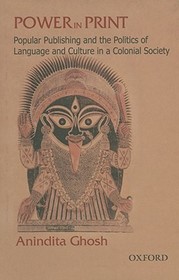
Power in Print
Popular Publishing and the Politics of Language and Culture in a Colonial Society, 1778-1905
- Publisher's listprice GBP 19.99
-
9 025 Ft (8 595 Ft + 5% VAT)
The price is estimated because at the time of ordering we do not know what conversion rates will apply to HUF / product currency when the book arrives. In case HUF is weaker, the price increases slightly, in case HUF is stronger, the price goes lower slightly.
- Discount 10% (cc. 903 Ft off)
- Discounted price 8 122 Ft (7 736 Ft + 5% VAT)
Subcribe now and take benefit of a favourable price.
Subscribe
9 025 Ft

Availability
Only to order.
Why don't you give exact delivery time?
Delivery time is estimated on our previous experiences. We give estimations only, because we order from outside Hungary, and the delivery time mainly depends on how quickly the publisher supplies the book. Faster or slower deliveries both happen, but we do our best to supply as quickly as possible.
Product details:
- Publisher OUP India
- Date of Publication 23 February 2006
- ISBN 9780195673296
- Binding Hardback
- No. of pages360 pages
- Size 220x147x26 mm
- Weight 603 g
- Language English
- Illustrations 1 map, 11 halftones, tables 0
Categories
Short description:
This volume explores a narrative of dissent, struggle, and conflict among various contending speech communities, and tries to analyse some fundamental debates on the cultural experience of the educated middle classes in nineteenth-century colonial Bengal.
MoreLong description:
By trying to explore a narrative of dissent, struggle, and conflict among various contending speech communities, this MS tries to have a re-look at some fundamental debates in the cultural experience of the educated middle classes in nineteenth century colonial Bengal. More specifically, it tries to study power and representation in colonial Bengal through the print-language and literature and its impact on the resultant identity formations. In the nineteenth century, language and its written literature was more than anything else, object of immense debate, scrutiny, and surveillance among the Bengalis and the colonial administration. But what is often less understood is that print languages and literature were also vital instruments for crafting social identities, and in a competitive environment like colonial Bengal, they offered substantial opportunities to indigenous groups to consolidated power along multiple axes of class, gender and community. By trying to relocate within the world of Bengali print groups previously thought to inhabit the peripheries of literate cultures, the volume also tries to challenge the conventional understandings of social formation in the nineteenth century.
...the first major account in English, and is therefore to be welcomed.
Table of Contents:
Introduction
Chapter 1. New Bengali and its Makers
Chapter 2. Language, Literature, and Reform
Chapter 3. The Battala Book Market
Chapter 4. Contesting Print Audiences
Chapter 5. Satire and Social Discord
Chapter 6. Women Refusing Conformity
Chapter 7. Bengali and its Muslim Other
Conclusion
Bibliography
Index

