

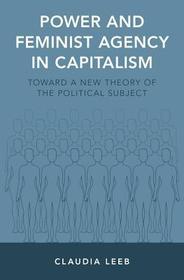
Power and Feminist Agency in Capitalism
Toward a New Theory of the Political Subject
- Publisher's listprice GBP 93.00
-
41 989 Ft (39 990 Ft + 5% VAT)
The price is estimated because at the time of ordering we do not know what conversion rates will apply to HUF / product currency when the book arrives. In case HUF is weaker, the price increases slightly, in case HUF is stronger, the price goes lower slightly.
- Discount 10% (cc. 4 199 Ft off)
- Discounted price 37 791 Ft (35 991 Ft + 5% VAT)
Subcribe now and take benefit of a favourable price.
Subscribe
41 989 Ft

Availability
printed on demand
Why don't you give exact delivery time?
Delivery time is estimated on our previous experiences. We give estimations only, because we order from outside Hungary, and the delivery time mainly depends on how quickly the publisher supplies the book. Faster or slower deliveries both happen, but we do our best to supply as quickly as possible.
Product details:
- Publisher OUP USA
- Date of Publication 8 June 2017
- ISBN 9780190639891
- Binding Hardback
- No. of pages240 pages
- Size 236x155x22 mm
- Weight 458 g
- Language English 0
Categories
Short description:
Power and Feminist Agency in Capitalism develops the idea of the political subject-in-outline to find solutions to the dilemmas inherent in the idea of the political subject, and provide answers to the when, who, how and what of socio-political change.
MoreLong description:
How do we become political subjects? Put another way, how do we become actors who have the power to instigate political change? These are questions that have long vexed political theorists, particularly feminist and critical race scholars who think about how to achieve real political transformation.
According to postmodern scholars, subjects are defined only through their relationship to institutions and social norms. But if we are only political people insofar as we are subjects of existing power relations, there is little hope of political transformation. To instigate change, we need to draw on collective power, but appealing to a particular type of subject, whether "working class," "black," or "women," will always be exclusionary. This issue is a particular problem for feminist scholars, who are frequently criticized for assuming that they can make broad claims for all women, while failing to acknowledge their own exclusive and powerful position (mostly white, Western, and bourgeois). Recent work in political and feminist thought has suggested that we can get around these paradoxes by wishing away the idea of political subjects entirely or else thinking of political identities as constantly shifting. In this book, Claudia Leeb argues that these are both failed ideas. She instead suggests a novel idea of a subject "in outline". As such, we are coherent political subjects, but we are always open, or in outline. It is this openness that both underscores the exclusionary character of political subjectivity and allows us to counter it. Leeb also argues that power structures that create political subjects are never all-powerful. While she rejects the idea of political autonomy, she shows that there is always a moment in which subjects can contest the power relations that define them. Over the course of the book Leeb grounds this concept of the subject in outline in work by Adorno, Lacan, and Marx -- the very theorists who are often seen as denying the agency of the subject. Specifically, she takes a critical look at the way that Judith Butler treats the political subjectivity of women and the ways in which Marx and Adorno treat the liberation of working class women.
Power and Feminist Agency manages to be simultaneously clear, comprehensive, and complex Leeb develops a new and more meaningful analysis that privileges a comparative anatomy of theoretical logics over and against a succession narrative. This is an analytical hierarchy worth endorsing Power and Feminist Agency stands on its own as a dazzling demonstration of dialectical reading that makes these questions-- what is capital? whither the feminist subject?-- both inextricable and newly urgent.
Table of Contents:
1. Introduction
Part I: The Subject-in-Outline
2. The When of Socio-Political Transformation: The Moment of the Limit
3. Who Changes the World: The Political Subject in Outline
4. How to Transform the World: Rethinking Theory and Practice
5. What makes us Rebel: Suffering Reconsidered
Part II: Applications
6. Rejecting the Politics of (Mis-)Recognition: Butler Revisited
7. The Working-Class Woman and Marx: Biased Constructions
8. Disrupting the Fantasy: Adorno and the Working-Class Woman
9. Conclusion
Index

