

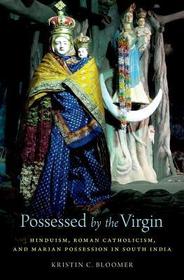
Possessed by the Virgin
Hinduism, Roman Catholicism, and Marian Possession in South India
- Publisher's listprice GBP 122.50
-
58 524 Ft (55 737 Ft + 5% VAT)
The price is estimated because at the time of ordering we do not know what conversion rates will apply to HUF / product currency when the book arrives. In case HUF is weaker, the price increases slightly, in case HUF is stronger, the price goes lower slightly.
- Discount 10% (cc. 5 852 Ft off)
- Discounted price 52 671 Ft (50 163 Ft + 5% VAT)
Subcribe now and take benefit of a favourable price.
Subscribe
58 524 Ft

Availability
printed on demand
Why don't you give exact delivery time?
Delivery time is estimated on our previous experiences. We give estimations only, because we order from outside Hungary, and the delivery time mainly depends on how quickly the publisher supplies the book. Faster or slower deliveries both happen, but we do our best to supply as quickly as possible.
Product details:
- Publisher OUP USA
- Date of Publication 4 January 2018
- ISBN 9780190615093
- Binding Hardback
- No. of pages348 pages
- Size 157x236x27 mm
- Weight 640 g
- Language English 0
Categories
Short description:
Possessed by the Virgin is an ethnographic account of three Roman Catholic women in Tamil Nadu, south India who claim to be possessed by Mary, the mother of Jesus. The author follows the lives of these women over many years, investigating questions about gender, social power, agency, and authenticity.
MoreLong description:
In the early 1980s, in a rural village in South India, a Dalit woman miscarried. She hovered on the edge of deathuntil the Virgin Mary led her to a chapel and possessed her. For years, hundreds of ailing Catholics and Hindus came to this woman for healing, and Mary made them well.
Two decades later, in the metropolis of Chennai, a boy named Alex lay in his hospital bed sick with fever when the Virgin Mary appeared to him and told him to walk. He didand at home, he felt Mary enter his body. Soon, his older cousin Rosalind also showed signs of Marian possession. Mary told them that her name was "Jecintho." Within three years, another young woman in Chennai also became possessed by Jecintho and began exhibiting signs of stigmata: blood flowing from her hands and eyes.
Possessed by the Virgin is an ethnographic account of Marian possession, healing, and exorcism among Catholics and Hindus in southeast India. Following the lives of three Tamil Roman Catholic women for more than a decade, Kristin C. Boomer attends to the women's own descriptions of their experience with Marian possession, as well as to those of the people who came to them for healing. Her book investigates how possession is possible and in what contexts such experiences can be read as authentic. Roman Catholic officials have responded in various ways: banning certain activities while promoting others. Their responses reflect the complicated relationship of the Roman Catholic Church with non-Christian religious practices on the Indian subcontinent, where "possession" (a term introduced by missionaries) involving deities and spirits has long been commonplace and where gods, goddesses and spirits have long inhabited people. This ground sets the stage for Bloomer to explore questions of agency, gender, subjectivity, and power, and the complex interconnection between the ethnographic "Self" and the "Other."
The study is a remarkable piece of work because it gives deep insights into hidden but highly popular religious practices that flourish in the borderland between local forms of Catholicism and Hinduism ... Possessed by the Virgin is highly recommended for readers with a general interest in the religious landscape of India and equally for scholars specialized in the Tamil sphere.
Table of Contents:
Acknowledgments
Dramatis Personae
Note on Transliteration
Regional Map of South India
Introduction
1. Rosalind
2. The Place, the People, the Practices:
Our Lady Jecintho and the Quest for
Embodied Wholeness
3. Authenticity and Double Trouble:
The Case of Nancy-as-Jecintho
4. Possession, Processions, and Authority
Interlude
5. Return to Maataapuram
6. Women's Work, Gendered Space,
And the Dangerous Labor of (Virgin) Birth
7. Memory, Mimesis, and Healing
8. Conclusion: Departures and Homecomings
Bibliography

