

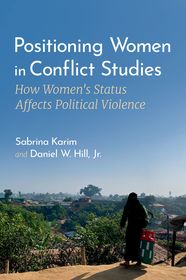
Positioning Women in Conflict Studies
How Women's Status Affects Political Violence
- Publisher's listprice GBP 19.99
-
9 025 Ft (8 595 Ft + 5% VAT)
The price is estimated because at the time of ordering we do not know what conversion rates will apply to HUF / product currency when the book arrives. In case HUF is weaker, the price increases slightly, in case HUF is stronger, the price goes lower slightly.
- Discount 20% (cc. 1 805 Ft off)
- Discounted price 7 220 Ft (6 876 Ft + 5% VAT)
- Discount is valid until: 30 June 2026
Subcribe now and take benefit of a favourable price.
Subscribe
9 025 Ft

Availability
Estimated delivery time: In stock at the publisher, but not at Prospero's office. Delivery time approx. 3-5 weeks.
Not in stock at Prospero.
Why don't you give exact delivery time?
Delivery time is estimated on our previous experiences. We give estimations only, because we order from outside Hungary, and the delivery time mainly depends on how quickly the publisher supplies the book. Faster or slower deliveries both happen, but we do our best to supply as quickly as possible.
Product details:
- Publisher OUP USA
- Date of Publication 19 December 2024
- ISBN 9780197757949
- Binding Paperback
- No. of pages328 pages
- Size 226x150x22 mm
- Weight 454 g
- Language English 564
Categories
Short description:
In Positioning Women in Conflict Studies, Sabrina Karim and Daniel W. Hill, Jr., re-evaluate the literature on gender, international politics, and conflict to reveal that the term "gender equality" is often used to refer to four distinct concepts: women's inclusion, women's rights, harm to women, and beliefs about women's roles. They develop original measures for each of these concepts and examine their impact on inter-state war onset, intra-state conflict onset, state repression/human rights violations, and terrorism. Overall, Karim and Hill demonstrate how the conceptualization and measurement of gender equality and women's status is critical in understanding how to reduce political violence globally.
MoreLong description:
For decades, scholars have asserted that gender matters when it comes to domestic and international politics and that gender equality means more than the rights and inclusion of women in the political sphere. Yet the existing research on gender equality and violent political conflict tends to equate and conflate gender equality with observable indicators related to women's inclusion in formal politics. Consequently, this conceptual problem has impeded efforts to theorize and empirically examine the connection between gender equality, women's status, and political violence.
In Positioning Women in Conflict Studies, Sabrina Karim and Daniel W. Hill, Jr., develop an original framework to study the condition of women in peace and conflict that avoids conflating gender equality with other terms. Karim and Hill re-evaluate the literature on gender, international politics, and conflict to reveal that the term "gender equality" is often used to refer to four distinct concepts: women's inclusion, women's rights, harm to women, and beliefs about women's roles. They develop original measures for each of these concepts and examine their impact on inter-state war onset, intra-state conflict onset, state repression/human rights violations, and terrorism. The results suggest that the relationships between women's status and political violence are not uniform and vary across different aspects of women's status as well as different types of political violence. Overall, Positioning Women in Conflict Studies demonstrates how the conceptualization and measurement of gender equality and women's status is critical in understanding how to reduce political violence globally.
Karim and Hill's book presents a provocative argument about conceptualizing and measuring women's status in political violence research. By providing cogent critiques coupled with practical solutions, their arguments have important implications for both scholars and policymakers. The result is an analysis that offers conceptual and definitional clarity, rigorous empirical tests, and new directions for future research on a critical topic.
Table of Contents:
Introduction
Part I: From "Gender (In)equality" to the Status of Women
Chapter 1: From "Gender (In)equality" to the Status of Women Solving the Concept Stretching Problem
Chapter 2: From "Gender (In)equality" to the Status of Women Solving the Measurement Invalidity Problem
Part II: The Status of Women and Political Violence
Chapter 3: Women's Inclusion and Political Violence
Chapter 4: Women's Rights and Political Violence
Chapter 5: Harm to Women and Political Violence
Chapter 6: Beliefs about Women's Gender Roles and Political Violence
Conclusion
Notes
References
Index

