

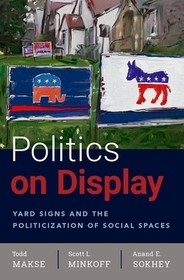
Politics on Display
Yard Signs and the Politicization of Social Spaces
- Publisher's listprice GBP 30.99
-
13 991 Ft (13 325 Ft + 5% VAT)
The price is estimated because at the time of ordering we do not know what conversion rates will apply to HUF / product currency when the book arrives. In case HUF is weaker, the price increases slightly, in case HUF is stronger, the price goes lower slightly.
- Discount 10% (cc. 1 399 Ft off)
- Discounted price 12 592 Ft (11 993 Ft + 5% VAT)
Subcribe now and take benefit of a favourable price.
Subscribe
13 991 Ft

Availability
Uncertain availability. Please turn to our customer service.
Why don't you give exact delivery time?
Delivery time is estimated on our previous experiences. We give estimations only, because we order from outside Hungary, and the delivery time mainly depends on how quickly the publisher supplies the book. Faster or slower deliveries both happen, but we do our best to supply as quickly as possible.
Product details:
- Publisher OUP USA
- Date of Publication 6 June 2019
- ISBN 9780190926328
- Binding Paperback
- No. of pages240 pages
- Size 155x234x15 mm
- Weight 363 g
- Language English 0
Categories
Short description:
Who displays yard signs? Why do they display them? In Politics on Display, we examine how neighborhoods become politicized during campaign seasons, exploring the causes and consequences of sign displaying and its implications for our understanding of political participation, attitudes about campaigns and elections, and social interaction in neighborhoods.
MoreLong description:
Political yard signs are one of the most ubiquitous and conspicuous features of American political campaigns, yet they have received relatively little attention as a form of political communication or participation. In Politics on Display, Todd Makse, Scott L. Minkoff, and Anand E. Sokhey tackle this phenomenon to craft a larger argument about the politics of identity and space in contemporary America. Documenting political life in two suburban communities and a major metropolitan area, they use an unprecedented research design that leverages street-level observation of the placement of yard signs and neighborhood-specific survey research that delves into the attitudes, behavior, and social networks of residents. The authors then integrate these data into a geo-database that also includes demographic and election data. Supplemented by nationally-representative data sources, the book brings together insights from political communication, political psychology, and political geography. Against a backdrop of conflict and division, this book advances a new understanding of how citizens experience campaigns, why many still insist on airing their views in public, and what happens when social spaces become political spaces.
MoreTable of Contents:
Chapter 1: Introduction: Seeing Signs from Different Perspectives
Chapter 2: The Research Design: Neighborhoods in the Spotlight
Chapter 3: Who Puts Their Politics on Display?
Chapter 4: "Not in My Front Yard": Investigating Attitudes about Signs
Chapter 5: Means, Motive and Opportunity: How People Come to Display Signs
Chapter 6: Patterns Real and Imagined: Analyzing Sign Displays in Neighborhood Space
Chapter 7: Lower Stakes: Sign Displays for Down Ballot Candidates
Chapter 8: Navigating Social Space: Signs, Perceptions and Neighborhood Social Interactions
Chapter 9: A New Perspective on Political Participation and Communication
Appendix
References

