

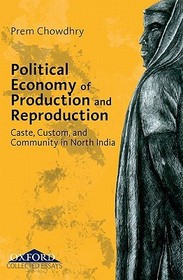
Political Economy of Production and Reproduction
- Publisher's listprice GBP 40.00
-
18 060 Ft (17 200 Ft + 5% VAT)
The price is estimated because at the time of ordering we do not know what conversion rates will apply to HUF / product currency when the book arrives. In case HUF is weaker, the price increases slightly, in case HUF is stronger, the price goes lower slightly.
- Discount 10% (cc. 1 806 Ft off)
- Discounted price 16 254 Ft (15 480 Ft + 5% VAT)
Subcribe now and take benefit of a favourable price.
Subscribe
18 060 Ft

Availability
Uncertain availability. Please turn to our customer service.
Why don't you give exact delivery time?
Delivery time is estimated on our previous experiences. We give estimations only, because we order from outside Hungary, and the delivery time mainly depends on how quickly the publisher supplies the book. Faster or slower deliveries both happen, but we do our best to supply as quickly as possible.
Product details:
- Publisher OUP India
- Date of Publication 3 February 2011
- ISBN 9780198067702
- Binding Hardback
- No. of pages464 pages
- Size 222x146x35 mm
- Weight 664 g
- Language English 0
Categories
Short description:
This volume discusses how the process of political democratization and radically altered legal enactments, especially relating to marriage and inheritance, have changed the dynamics of power relations, primarily in North India.
MoreLong description:
In post-colonial India, the process of political democratization and radically altered legal enactments, especially relating to marriage and inheritance, have changed the dynamics of power relations. The essays included in this volume are selected with a view to achieve an understanding of contemporary north India, along with all its social, familial, and legal contradictions. Spanning the mid nineteenth to the twenty-first century, the author presents a special case
study of Haryana. This elucidates how the richest regions in the area continue to be regressive instead of moving towards the modern egalitarian statehood. The in-depth analysis, however, is broadly applicable to the whole of northern India in sharing socio-cultural concerns.
The new, greatly liberalized, political economy of the post-Green revolution; globalization marked by conspicuous consumption; and the quasi-urbanization that rural north India has undergone; have all had their fall-out on rural society. These have led to new class formations, westernization, and changes in the notions of social status and power relations. They have, in turn, impacted familial, inter-generation, and gender relations.

