

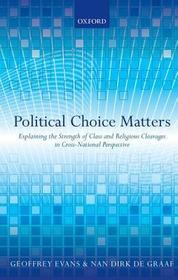
Political Choice Matters
Explaining the Strength of Class and Religious Cleavages in Cross-National Perspective
- Publisher's listprice GBP 152.50
-
68 853 Ft (65 575 Ft + 5% VAT)
The price is estimated because at the time of ordering we do not know what conversion rates will apply to HUF / product currency when the book arrives. In case HUF is weaker, the price increases slightly, in case HUF is stronger, the price goes lower slightly.
- Discount 10% (cc. 6 885 Ft off)
- Discounted price 61 968 Ft (59 018 Ft + 5% VAT)
Subcribe now and take benefit of a favourable price.
Subscribe
68 853 Ft

Availability
printed on demand
Why don't you give exact delivery time?
Delivery time is estimated on our previous experiences. We give estimations only, because we order from outside Hungary, and the delivery time mainly depends on how quickly the publisher supplies the book. Faster or slower deliveries both happen, but we do our best to supply as quickly as possible.
Product details:
- Publisher OUP Oxford
- Date of Publication 28 March 2013
- ISBN 9780199663996
- Binding Hardback
- No. of pages472 pages
- Size 240x162x31 mm
- Weight 862 g
- Language English 0
Categories
Short description:
Studies of the influence of class and religion on politics often point to their gradual decline as a result of social change. Backed up by extensive evidence from 11 case studies and a 15-country pooled analysis, the editors argue instead that the supply of choices by parties influences the extent of class divisions: political choice matters.
MoreLong description:
Political Choice Matters investigates the extent to which class and religion influence party choice in contemporary democracies. Rather than the commonly-assumed process in which a weakening of social boundaries leads to declining social divisions in political preferences, this book's primary message is that the supply of choices by parties influences the extent of such divisions: hence, political choice matters. Combining overtime, cross-national data, and multi-level research designs the authors show how policy and programmatic positions adopted by parties provide voters with choice sets that accentuate or diminish the strength of political cleavages. The book gives central place to the positions of political parties on left-right, economically redistributive and morally conservative versus social liberal dimensions. Evidence on these positions is obtained primarily from the Comparative Manifesto Project, with a chapter dedicated to elaborating and validating the various implementations of this uniquely valuable source of evidence on party positions. The primary empirical focus includes case studies of 11 Western, Southern, and Central European societies as well as 'anglo-democracies' including Britain, USA, Canada, and Australia. These detailed analyses of election studies ranging in some cases from the post-war period until the early part of the 21st century are augmented by a pooled cross-national and overtime analysis of 15 Western democracies using a unique, combined dataset of 188 national surveys. The authors show that although there has been some overtime decline in the strength of association between social class and party choice, this is far smaller than the amount of change in the relationship occurring as a result of party movements on questions of inequality and redistribution. The strength of the religiosity cleavage is also influenced by changes in party positions on moral issues - changes that can be understood as a strategic response to a process of secularization that has weakened the electoral viability of parties deriving support from appeals to religious values.
The electoral coalitions assembled by parties of different ideological stripes in todays established Western democracies are not simply a reflection of cross-national or inter-temporal differences in social structure; they also respond to the programmatic appeals of the parties, and more specifically the strategic configuration of programmatic moderation or polarization among them. Drawing on the most comprehensive cross-national and cross-time dataset available to date, and supplemented by a battery of meticulous case studies, this book drives home this crucial point in a more convincing way than any previous study. It is required reading for anyone probing into the realignments of partisan politics in postindustrial democracies and looking for methodological guidance in advancing that enterprise.
Table of Contents:
Part I: Models, Measurement and Comparative Analysis
Explaining Cleavage Strength: The Role of Party Positions
Measuring Party Positions
Examining The Impact of Party Positions and Class Voting in 15 Western Democracies: A Pooled Analysis
Part II: The Case Studies
Anglo-Saxon Democracies
Ideological Convergence and the Decline of Class Voting in Britain
The United States: Still the Politics of Diversity
The Declining Impact of Class on the Vote in Australia: Testing Competing Explanations
The Class-Party Relationship in Canada, 1965- 2004
Mainland Europe
Enduring Divisions and New Dimensions: Class Voting in Denmark
The Political Evolution of Class and Religion: An Interpretation for the Netherlands 1971-2006
Political Change and Cleavage Voting in France: Class, Religion, Political Appeals, and Voter Alignments (1962-2007)
Social Divisions and Political Choices in Germany, East and West, 1980-2006
Class and Religious Voting in Italy: The Rise of PolicyResponsiveness
Recent Democracies
Do Social Divisions Explain Political Choices? The Case of Poland
Social Class, Religiosity, and Vote Choice in Spain, 1979-2008
Part III: Concluding observations
The Importance of Political Choice and Other Lessons Learned
Bibliography
Index

