

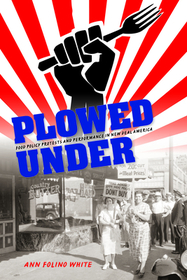
Plowed Under – Food Policy Protests and Performance in New Deal America
Food Policy Protests and Performance in New Deal America
- Publisher's listprice GBP 22.99
-
10 983 Ft (10 460 Ft + 5% VAT)
The price is estimated because at the time of ordering we do not know what conversion rates will apply to HUF / product currency when the book arrives. In case HUF is weaker, the price increases slightly, in case HUF is stronger, the price goes lower slightly.
- Discount 10% (cc. 1 098 Ft off)
- Discounted price 9 885 Ft (9 414 Ft + 5% VAT)
Subcribe now and take benefit of a favourable price.
Subscribe
10 983 Ft

Availability
Estimated delivery time: In stock at the publisher, but not at Prospero's office. Delivery time approx. 3-5 weeks.
Not in stock at Prospero.
Why don't you give exact delivery time?
Delivery time is estimated on our previous experiences. We give estimations only, because we order from outside Hungary, and the delivery time mainly depends on how quickly the publisher supplies the book. Faster or slower deliveries both happen, but we do our best to supply as quickly as possible.
Product details:
- Publisher MH – Indiana University Press
- Date of Publication 11 November 2014
- Number of Volumes Print PDF
- ISBN 9780253015402
- Binding Paperback
- No. of pages314 pages
- Size 229x152x17 mm
- Weight 460 g
- Language English
- Illustrations 22 b&w illus. 0
Categories
Long description:
"
During the Great Depression, with thousands on bread lines, farmers were instructed by the New Deal Agricultural Adjustment Act to produce less food in order to stabilize food prices and restore the market economy. Fruit was left to rot on trees, crops were plowed under, and millions of piglets and sows were slaughtered and discarded. Many Americans saw the government action as a senseless waste of food that left the hungry to starve, initiating public protests against food and farm policy. White approaches these events as performances where competing notions of morality and citizenship were acted out, often along lines marked by class, race, and gender. The actions range from the ""Milk War"" that pitted National Guardsmen against dairymen, who were dumping milk, to the meat boycott staged by Polish-American women in Michigan, and from the black sharecroppers' protest to restore agricultural jobs in Missouri to the protest theater of the Federal Theater Project. White provides a riveting account of the theatrical strategies used by consumers, farmers, agricultural laborers, and the federal government to negotiate competing rights to food and the moral contradictions of capitalist society in times of economic crisis.
" More
