

- Publisher's listprice GBP 9.99
-
4 510 Ft (4 295 Ft + 5% VAT)
The price is estimated because at the time of ordering we do not know what conversion rates will apply to HUF / product currency when the book arrives. In case HUF is weaker, the price increases slightly, in case HUF is stronger, the price goes lower slightly.
- Discount 10% (cc. 451 Ft off)
- Discounted price 4 059 Ft (3 866 Ft + 5% VAT)
Subcribe now and take benefit of a favourable price.
Subscribe
4 510 Ft

Availability
Estimated delivery time: In stock at the publisher, but not at Prospero's office. Delivery time approx. 3-5 weeks.
Not in stock at Prospero.
Why don't you give exact delivery time?
Delivery time is estimated on our previous experiences. We give estimations only, because we order from outside Hungary, and the delivery time mainly depends on how quickly the publisher supplies the book. Faster or slower deliveries both happen, but we do our best to supply as quickly as possible.
Product details:
- Publisher OUP Oxford
- Date of Publication 13 February 2003
- ISBN 9780192802163
- Binding Paperback
- No. of pages128 pages
- Size 177x112x7 mm
- Weight 112 g
- Language English
- Illustrations 12 halftones and numerous text boxes 60
Categories
Short description:
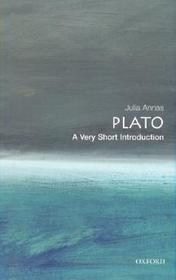
This book focuses on the philosophy and argument of Plato's writings, drawing the reader into Plato's way of doing philosophy and the general themes of his thinking. It discusses Plato's style of writing: his use of the dialogue form, his use of what we today call fiction, and his philosophical transformation of myths. It also looks at his discussions of love and philosophy, his attitude to women, and to homosexual love. It explores Plato's claim that virtue is sufficient for happiness and touches on his arguments for the immortality of the soul and his ideas about the nature of the universe.
MoreLong description:
This lively and accessible introduction to Plato focuses on the philosophy and argument of his writings, drawing the reader into Plato's way of doing philosophy, and the general themes of his thinking. This is not a book to leave the reader standing in the outer court of introduction and background information, but leads directly into Plato's argument. It looks at Plato as a thinker grappling with philosophical problems in a variety of ways, rather than a philosopher with a fully worked-out system. It includes a brief account of Plato's life and the various interpretations that have been drawn from the sparse remains of information. It stresses the importance of the founding of the Academy and the conception of philosophy as a subject. Julia Annas discusses Plato's style of writing: his use of the dialogue form, his use of what we today call fiction, and his philosophical transformation of myths. She also looks at his discussions of love and philosophy, his attitude to women, and to homosexual love, explores Plato's claim that virtue is sufficient for happiness, and touches on his arguments for the immortality of the soul and his ideas about the nature of the universe.
ABOUT THE SERIES: The Very Short Introductions series from Oxford University Press contains hundreds of titles in almost every subject area. These pocket-sized books are the perfect way to get ahead in a new subject quickly. Our expert authors combine facts, analysis, perspective, new ideas, and enthusiasm to make interesting and challenging topics highly readable.
Table of Contents:
Arguing with Plato
Plato's name, and other matters
Drama, fiction and the elusive author
Love, sex, gender and philosophy
Vitue in me and in my society
My soul and myself
The nature of things

