

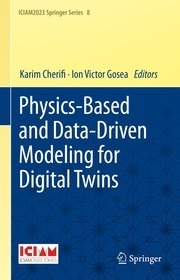
Physics-Based and Data-Driven Modeling for Digital Twins
Series: ICIAM2023 Springer Series; 8;
-
GET 12% OFF
- Publisher's listprice EUR 213.99
-
83 584 Ft (79 604 Ft + 5% VAT)
The price is estimated because at the time of ordering we do not know what conversion rates will apply to HUF / product currency when the book arrives. In case HUF is weaker, the price increases slightly, in case HUF is stronger, the price goes lower slightly.
- Discount 12% (cc. 10 030 Ft off)
- Discounted price 73 554 Ft (70 052 Ft + 5% VAT)
73 554 Ft

Availability
Not yet published.
Why don't you give exact delivery time?
Delivery time is estimated on our previous experiences. We give estimations only, because we order from outside Hungary, and the delivery time mainly depends on how quickly the publisher supplies the book. Faster or slower deliveries both happen, but we do our best to supply as quickly as possible.
Product details:
- Publisher Springer Nature Singapore
- Date of Publication 5 August 2026
- Number of Volumes 1 pieces, Book
- ISBN 9789819691074
- Binding Hardback
- No. of pages154 pages
- Size 235x155 mm
- Language English
- Illustrations VII, 154 p. 68 illus., 50 illus. in color. Illustrations, black & white 700
Categories
Long description:
"
This book presents a compelling and up-to-date exploration of modeling techniques for digital twins, a transformative concept revolutionizing how physical assets are designed, operated, optimized, and managed throughout their lifecycle. Digital twins are precise virtual counterparts of physical systems, capable of integrating real-time data to offer dynamic, predictive insights into system behavior. As this paradigm gains momentum across industries, it enhances decision-making and operational efficiency but also introduces new mathematical and engineering challenges in model development.
At the core of this volume is a thorough investigation into the modeling frameworks essential for building effective digital twins. These systems must fulfill multifunctional roles, requiring models that are both robust and flexible enough to simulate complex physical processes with high fidelity. The book spans a wide spectrum of approaches from physics-based models grounded in the laws of nature to data-driven techniques that harness large-scale datasets. It also highlights the growing importance of hybrid methods that combine the interpretability of physical models with the adaptability of machine learning. Throughout the book, real-world case studies illustrate how these modeling advancements are applied to solve pressing challenges in sectors such as manufacturing, energy and transportation.
This volume brings together contributions from leading researchers who are shaping the future of digital twins. The chapters are designed to be accessible to a broad audience. Whether you just started or want to deepen your expertise, this volume offers the insights and tools needed to engage with one of the most exciting developments in modern applied mathematics and engineering. Chapter 1 is available open access under licensed under the Creative Commons Attribution-NonCommercial-NoDerivatives 4.0 International License in link.springer.com.
" MoreTable of Contents:
"
Chapter 1 The (Executable) Digital Twin: merging the digital and the physical worlds.- Chapter 2 Digital Twins: modeling hierarchy and basic approaches.- Chapter 3 Adaptive planning for risk-aware predictive digital twins.- Chapter 4 Recurrent deep Kernel Learning of Dynamical Systems.-Chapter 5 Hierarchical modeling for an industrial implementation of a digital twin for electrical drives.-Chapter 6 Deviation-sensitive black-box anomaly attribution.
" More
