

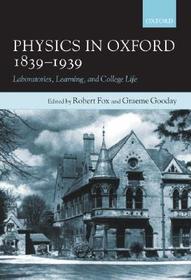
Physics in Oxford, 1839-1939
Laboratories, Learning and College Life
- Publisher's listprice GBP 152.50
-
68 853 Ft (65 575 Ft + 5% VAT)
The price is estimated because at the time of ordering we do not know what conversion rates will apply to HUF / product currency when the book arrives. In case HUF is weaker, the price increases slightly, in case HUF is stronger, the price goes lower slightly.
- Discount 10% (cc. 6 885 Ft off)
- Discounted price 61 968 Ft (59 018 Ft + 5% VAT)
Subcribe now and take benefit of a favourable price.
Subscribe
68 853 Ft

Availability
printed on demand
Why don't you give exact delivery time?
Delivery time is estimated on our previous experiences. We give estimations only, because we order from outside Hungary, and the delivery time mainly depends on how quickly the publisher supplies the book. Faster or slower deliveries both happen, but we do our best to supply as quickly as possible.
Product details:
- Publisher OUP Oxford
- Date of Publication 16 June 2005
- ISBN 9780198567929
- Binding Hardback
- No. of pages386 pages
- Size 254x178x25 mm
- Weight 949 g
- Language English
- Illustrations numerous haltftones, line drawings and tables 0
Categories
Short description:
This book shows that physics in pre-war Oxford has a colourful and dynamic history. Its examination of physics teaching and research in the University's constituent colleges reveals a unique world that helped to make Oxford physics in the twentieth century a force to rival that of the Cavendish Laboratory at Cambridge.
MoreLong description:
Physics in Oxford, 1839-1939 offers a challenging new interpretation of pre-war physics at the University of Oxford, which was far more dynamic than most historians and physicists have been prepared to believe. It explains, on the one hand, how attempts to develop the University's Clarendon Laboratory by Robert Clifton, Professor of Experimental Philosophy from 1865 to 1915, were thwarted by academic politics and funding problems, and latterly by Clifton's idiosyncratic concern with precision instrumentation. Conversely, by examining in detail the work of college fellows and their laboratories, the book reconstructs the decentralized environment that allowed physics to enter on a period of conspicuous vigour in the late nineteenth and early twentieth centuries, especially at the characteristically Oxonian intersections between physics, physical chemistry, mechanics, and mathematics. Whereas histories of Cambridge physics have tended to focus on the self-sustaining culture of the Cavendish Laboratory, it was Oxford's college-trained physicists who enabled the discipline to flourish in due course in university as well as college facilities, notably under the newly appointed professors, J. S. E. Townsend from 1900 and F. A. Lindemann from 1919. This broader perspective allows us to understand better the vitality with which physicists in Oxford responded to the demands of wartime research on radar and techniques relevant to atomic weapons and laid the foundations for the dramatic post-war expansion in teaching and research that has endowed Oxford with one of the largest and most dynamic schools of physics in the world.
MoreTable of Contents:
Physics in Oxford: problems and perspectives
The context and practices of Oxford physics, 1839-77
Robert Bellamy Clifton and the 'depressing inheritance' of the Clarendon Laboratory, 1877-1919
Laboratories and physics in Oxford colleges, 1848-1947
Mechanical physicists, the Millard Laboratory and the transition from physics to engineering
Translating ion physics from Cambridge to Oxford: John Townsend and the Electrical Laboratory, 1900-24
The Lindemann era
Redefining the context: Oxford and the wider world of British physics, 1900-40
Epilogue

