

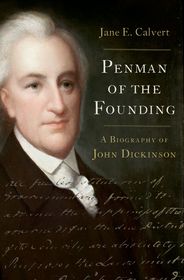
Penman of the Founding
A Biography of John Dickinson
- Publisher's listprice GBP 26.99
-
12 185 Ft (11 605 Ft + 5% VAT)
The price is estimated because at the time of ordering we do not know what conversion rates will apply to HUF / product currency when the book arrives. In case HUF is weaker, the price increases slightly, in case HUF is stronger, the price goes lower slightly.
- Discount 20% (cc. 2 437 Ft off)
- Discounted price 9 748 Ft (9 284 Ft + 5% VAT)
- Discount is valid until: 30 June 2026
Subcribe now and take benefit of a favourable price.
Subscribe
12 185 Ft

Availability
Estimated delivery time: In stock at the publisher, but not at Prospero's office. Delivery time approx. 3-5 weeks.
Not in stock at Prospero.
Why don't you give exact delivery time?
Delivery time is estimated on our previous experiences. We give estimations only, because we order from outside Hungary, and the delivery time mainly depends on how quickly the publisher supplies the book. Faster or slower deliveries both happen, but we do our best to supply as quickly as possible.
Product details:
- Publisher OUP USA
- Date of Publication 9 January 2025
- ISBN 9780197541692
- Binding Hardback
- No. of pages608 pages
- Size 243x165x40 mm
- Weight 1052 g
- Language English
- Illustrations 24 569
Categories
Short description:
John Dickinson, one of the architects of the Constitution--and the main author of its predecessor, the Articles of Confederation--refused to sign the Declaration of Independence. His notion of rebellion was of civil disobedience rather than violent overthrow. Dickinson has been portrayed as a cooler head in a moment of hotheads; a Quaker in all but name. During his lifetime, Dickinson freed his slaves, even paid reparations, and advocated extending greater rights for women and Native Americans. He also served in the Continental Army, despite his Quaker principles, and fought with distinction. Written by the foremost expert on Dickinson, Jane E. Calvert's book shines a new light on this lesser-known but crucially important founding figure.
MoreLong description:
Why is it that so many Americans have not heard of John Dickinson?
John Dickinson of Pennsylvania and Delaware was an early leader of the resistance to British rule in the American colonies. In fact, to many, he was the most prominent figure in the struggle for independence, though his Quaker-influenced opposition to violence kept him from signing one of its most famous documents in July 1776. Still, Dickinson, one of the wealthiest men in the colonies, did more to promote the cause behind it than almost anyone else, not only as the lead draftsman in all the national Congresses, but in his popular writing. His hugely influential Letters from a Farmer in Pennsylvania educated colonists about their rights and instructed them in how to defend those rights in non-violent ways. In essence he taught the colonists to think of themselves as Americans, united in a common cause. Despite his refusal to sign the Declaration of Independence, he continued to serve the nation in a number of capacities--in Congress, as governor of Delaware and Pennsylvania, as president of the Annapolis Convention, as delegate to the Federal Convention, and as president of the Delaware constitutional convention. Because of his close association with Quakerism, he also took stances unlike any other major figure of his day, making him among the first to advocate civil disobedience as a form of protest, freeing his slaves and embracing abolitionism, advocating rights for women, Indians, prisoners, and the poor. He nonetheless volunteered for active service in the Delaware militia during the War of Independence.
Despite the key part he played in the country's founding, few Americans today have heard of John Dickinson. Early chroniclers and historians, seeking to create a patriotic narrative and taking their cues from his political enemies, cast him as a coward and Loyalist for not signing the Declaration. Many later historians have simply accepted and echoed this distorted and dismissive view. Jane Calvert's fascinating, authoritative, and accessible biography, the first complete account of Dickinson's life and work, restores him to a place of prominence in the nation's formative years.
Vivid and gripping.
Table of Contents:
Introduction
Prologue: "The most distinguished of patriots":
Congress Remembers John Dickinson, February 1808
Chapter One: "Nursd in the Arms of Liberty":
Youth and Education, 1732-1750
Chapter Two: "The Noblest Aim of Human Abilities & Industry":
Legal Training in London, 1753-1757
Chapter Three: "Defending the Innocent & redressing the Injurd":
Practicing Law in Philadelphia, 1757-1759
Chapter Four: "Congratulate me on my Salvation":
Election to Public Office, 1759-1764
Chapter Five: "Created in us by the decrees of Providence":
The Stamp Act Resistance, 1765-1766
Chapter Six: "By uniting We stand, by dividing We fall":
The Townshend Acts and the Rise of the Farmer, 1767-1768
Chapter Seven: "Pursue moderate measures with vigour":
Leader of the Resistance, 1769-1773
Chapter Eight: "Freedom or an honorable Death":
The Continental Congresses, 1774-1775
Chapter Nine: "As the rock among the waves":
Supporting America Against Americans, 1776-1777
Chapter Ten: "From the Mist of Doubts to the Sunshine of Belief":
A Turn Towards Quakerism and a Return to Politics, 1778-1781
Chapter Eleven: "How unexpected & distressing this Event":
President of Delaware, 1781-1782
Chapter Twelve: "Through a Wilderness of Difficulties":
President of Pennsylvania, 1782-1785
Chapter Thirteen: "A labour of public love":
Reconstituting the People, 1786-1793
Chapter Fourteen: "I love Mankind":
A Citizen Activist, 1794-1799
Chapter Fifteen: "A constant Watchman for the public Interest":
A Politician Behind the Scenes, 1800-1808
Epilogue: "My name remembered by Posterity":
The Dismantling of a Legacy, 1808-2023
Index

