

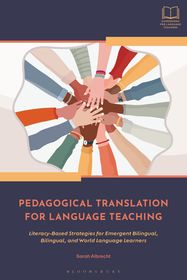
Pedagogical Translation for Language Teaching
Literacy-Based Strategies for Emergent Bilingual, Bilingual, and World Language Learners
Series: Bloomsbury Guidebooks for Language Teachers;
-
GET 18% OFF
- Publisher's listprice GBP 28.99
-
13 849 Ft (13 190 Ft + 5% VAT)
The price is estimated because at the time of ordering we do not know what conversion rates will apply to HUF / product currency when the book arrives. In case HUF is weaker, the price increases slightly, in case HUF is stronger, the price goes lower slightly.
- Discount 18% (cc. 2 493 Ft off)
- Discounted price 11 357 Ft (10 816 Ft + 5% VAT)
- Discount is valid until: 31 March 2026
11 357 Ft

Availability
Estimated delivery time: In stock at the publisher, but not at Prospero's office. Delivery time approx. 3-5 weeks.
Not in stock at Prospero.
Why don't you give exact delivery time?
Delivery time is estimated on our previous experiences. We give estimations only, because we order from outside Hungary, and the delivery time mainly depends on how quickly the publisher supplies the book. Faster or slower deliveries both happen, but we do our best to supply as quickly as possible.
Product details:
- Publisher Bloomsbury Publishing (UK)
- Date of Publication 22 January 2026
- Number of Volumes Paperback
- ISBN 9781350412743
- Binding Paperback
- No. of pages256 pages
- Size 232x156x18 mm
- Weight 300 g
- Language English 690
Categories
Long description:
This book combines translation and second language acquisition with literacy as a social practice for a powerful new approach to language teaching and learning. It provides the reader with transdisciplinary theoretical grounding, an overview of translation benefits and approaches, and sample translation activities as guidance for applying translation as a collaborative pedagogical tool in K-12 and postsecondary language-learning environments. These environments may range from monolingual with emergent bilinguals, bilingual, heritage, or world language (including English as a Foreign Language).
Recommended texts for translation across languages range from oral, written, and multimodal. Alongside these, all of the book's translation activities include suggestions for modification according to age, language level, and language-learning environment. Flexibility in formulation of language and literacy objectives and assessments is a key component, with potential modifications according to varying standards, such as CEFR, ACTFL, Common Core, and standards for biliteracy.
Readers from all language instruction environments will be able to understand the benefits of and need for pedagogical translation, incorporate pedagogical translation activities into already-established content, design and modify pedagogical translation activities, and develop standards-based objectives and evaluations for translation-based activities.
Table of Contents:
Introduction: Connecting Literacy, Translation and Language Learning
Part I: Translation and Literacy
1. Translation in Language Learning Reborn
2. Literacy and Language Learning
3. Translation and Second Language Acquisition
4. Foundations: Approaches to translation
Part II: Translation for Linguistic and Cultural Learning
5. Literacy, Translation and Linguistic Learning
6. Literacy, Translation and Cultural Learning
7. The Potential of Authentic Texts
8. Changing Modalities
Part III: Considerations in Teaching Translation
9. The Benefits of Collaboration
10. Literacy Objectives and Measuring Learning
11. Considerations in Teacher Preparation
Conclusion: Moving Towards Equitable Outcomes in Language Learning
Appendices

