

- Publisher's listprice GBP 15.99
-
7 219 Ft (6 875 Ft + 5% VAT)
The price is estimated because at the time of ordering we do not know what conversion rates will apply to HUF / product currency when the book arrives. In case HUF is weaker, the price increases slightly, in case HUF is stronger, the price goes lower slightly.
- Discount 20% (cc. 1 444 Ft off)
- Discounted price 5 775 Ft (5 500 Ft + 5% VAT)
- Discount is valid until: 30 June 2026
Subcribe now and take benefit of a favourable price.
Subscribe
7 219 Ft

Availability
Not yet published.
Why don't you give exact delivery time?
Delivery time is estimated on our previous experiences. We give estimations only, because we order from outside Hungary, and the delivery time mainly depends on how quickly the publisher supplies the book. Faster or slower deliveries both happen, but we do our best to supply as quickly as possible.
Product details:
- Publisher Bloomsbury Publishing (UK)
- Date of Publication 21 May 2026
- ISBN 9781472873620
- Binding Paperback
- No. of pages80 pages
- Size 248x184x8 mm
- Weight 258 g
- Language English
- Illustrations Colour illustrations throughout, including profiles, technical drawings, battlescene artworks, maps and photographs. 700
Categories
Short description:
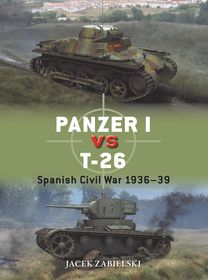
This fully illustrated study pits Germany's Panzer I against the Soviet T-26 in the Spanish Civil War.
MoreLong description:
This fully illustrated study pits Germany's Panzer I against the Soviet T-26 in the Spanish Civil War.
In 1936, as Spain descended into civil war, both Nazi Germany and the Soviet Union sent tanks to aid the opposing sides, keen to see how they fared in combat. Armed with twin machine guns, Germany's Panzer I fought alongside Nationalist troops, while the 45mm-armed Soviet T-26 took the field with Republican forces, with captured examples soon equipping the Nationalists. In this book, Jacek Zabielski reveals the origins, development and combat history of these two types, which remained in front-line service in 1941 as Hitler's forces invaded the Soviet Union.
While both types were soon outclassed by better-armed and -armoured successors, the lessons learned in Spain would shape German and Soviet combined-arms doctrine on the Eastern Front during and after Operation Barbarossa. Featuring specially commissioned artwork, full-colour mapping and archive photographs alongside the authoritative text, this study reveals how the Panzer I and T-26 performed in battle, and their technical and tactical influence throughout World War II.
Table of Contents:
Introduction
Chronology
Design and Development
Technical Specifications
The Combatants
The Strategic Situation
Combat
Statistics and Analysis
Aftermath
Bibliography
Index

