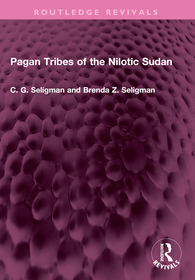
Pagan Tribes of the Nilotic Sudan
Series: Routledge Revivals;
- Publisher's listprice GBP 40.99
-
19 582 Ft (18 650 Ft + 5% VAT)
The price is estimated because at the time of ordering we do not know what conversion rates will apply to HUF / product currency when the book arrives. In case HUF is weaker, the price increases slightly, in case HUF is stronger, the price goes lower slightly.
- Discount 10% (cc. 1 958 Ft off)
- Discounted price 17 624 Ft (16 785 Ft + 5% VAT)
Subcribe now and take benefit of a favourable price.
Subscribe
19 582 Ft

Availability
Not yet published.
Why don't you give exact delivery time?
Delivery time is estimated on our previous experiences. We give estimations only, because we order from outside Hungary, and the delivery time mainly depends on how quickly the publisher supplies the book. Faster or slower deliveries both happen, but we do our best to supply as quickly as possible.
Product details:
- Edition number 1
- Publisher Routledge
- Date of Publication 1 December 2025
- ISBN 9781032730349
- Binding Paperback
- No. of pages718 pages
- Size 246x174 mm
- Language English 700
Categories
Short description:
First published in 1932, Pagan Tribes of the Nilotic Sudan is a general conspectus of the people, traditions, culture, and ways of thought in southern Sudan.
MoreLong description:
First published in 1932, Pagan Tribes of the Nilotic Sudan is a general conspectus of the people, traditions, culture, and ways of thought in southern Sudan. The authors give their view of the remote racial origins of the people with whom their studies are concerned and then of the great sub-racial units whom they class as ‘dolichocephals’ and ‘mesaticephals’ respectively. The former comprise, first, the Nilotes – Shilluk, Nuer and Dinka, who live and move and have their being in an atmosphere of cattle, and who, it is thought, had their cradleland somewhere east of the Great Lakes – and, second, the Nilo-Hamites, such as the true Bari, various Lotuko-speaking tribes, etc. The mesaticephals consist of the Fung-Nuba peoples on the one hand and, on the other, the South-Western group of whom Azande are the best known. Exceptional interest is attached to the research conducted among the Bari. The social organization of this tribe is complex and curious, particularly their beliefs regarding rain-stones, rainmakers and clouds. The language used is a reflection of its era and no offence is meant by the Publishers to any reader by this republication. This book will be of interest to students of history, anthropology, ethnography, and ethnic studies.
MoreTable of Contents:
List of Plates List of Text-figures Foreword Introduction Note on Transliteration List of Abbreviations Used 1. Prolegomena 2. The Shilluk 3. The Shilluk (cont.) 4. The Dinka 5. The Dinka (cont.) 6. The Nuer 7. The Bari 8. The Bari (cont.) 9. The Lotuko 10. The Lotuko-speaking Tribes 11. The Nuba 12. Darfung 13. Darfur 14. Tribes of the South-Western Bahr el Ghazal 15. The Azande Appendix Index
More


Return of the Black Knight: Reflections on Africa and the Construction of Medieval European Identity