

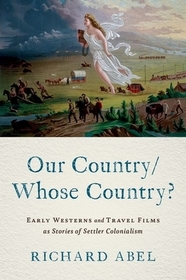
Our Country/Whose Country?
Early Westerns and Travel Films as Stories of Settler Colonialism
- Publisher's listprice GBP 27.49
-
12 411 Ft (11 820 Ft + 5% VAT)
The price is estimated because at the time of ordering we do not know what conversion rates will apply to HUF / product currency when the book arrives. In case HUF is weaker, the price increases slightly, in case HUF is stronger, the price goes lower slightly.
- Discount 20% (cc. 2 482 Ft off)
- Discounted price 9 929 Ft (9 456 Ft + 5% VAT)
- Discount is valid until: 30 June 2026
Subcribe now and take benefit of a favourable price.
Subscribe
12 411 Ft

Availability
Estimated delivery time: In stock at the publisher, but not at Prospero's office. Delivery time approx. 3-5 weeks.
Not in stock at Prospero.
Why don't you give exact delivery time?
Delivery time is estimated on our previous experiences. We give estimations only, because we order from outside Hungary, and the delivery time mainly depends on how quickly the publisher supplies the book. Faster or slower deliveries both happen, but we do our best to supply as quickly as possible.
Product details:
- Publisher OUP USA
- Date of Publication 1 February 2024
- ISBN 9780197744055
- Binding Paperback
- No. of pages256 pages
- Size 160x236x9 mm
- Weight 376 g
- Language English
- Illustrations 50 B&W halftones 475
Categories
Short description:
This book offers an original analysis of early westerns and travel pictures through the lens of settler colonialism, exploring their remarkable vision of white settlers' westward expansion and how they revealed a profound transformation in American culture and the vision of "American Progress."
MoreLong description:
The concept of settler colonialism offers an invaluable lens to reframe early westerns and travel pictures as re-enactments of the United States' repressed past. Westerns in particular propose a remarkable vision of white settlers' westward expansion that reveals a transformation in what "American Progress" came to mean.
Initially, these films tracked settlers moving westward across the Appalachians, Great Plains, and Rockies. Their seizure of "empty land" provoked continual resistance from Indigenous peoples and Mexicans; "pioneers" suffered extreme hardships, but heroic male figures usually scattered or wiped out those "aliens." Some films indulged in nostalgic empathy for the Indian as a "Vanishing American." In the early 1910s, westerns became increasingly popular. In Indian pictures, Native Americans ranged from devious savages, victims of white violence, and "Noble Savages" to "in-between" figures caught between cultures and "mixed-descent peoples" partnered for security or advantage. Mexicans took positions across a similar spectrum. In cowboy and cowgirl films, "ordinary" whites became heroes and heroines fighting outlaws; and bandits like Broncho Billy underwent transformation into "good badmen."
The mid to late 1910s saw a shift, as Indian pictures and cowgirl films faded and male figures, embodied by movie stars, dominated popular series. In different ways, William S. Hart and Harry Carey reinvented the "good badman" as a stoic, if troubled, figure of white masculinity. In cowboy films of comic romance, Tom Mix engaged in dangerous stunts and donned costumes that made him a fashionable icon. In parodies, Douglas Fairbanks subverted the myth of "American Progress," sporting a nonchalant grin of effortless self-confidence. Nearly all of their films assumed firmly settled white communities, rarely threatened by Indians or Mexicans. Masked as "Manifest Destiny," the expropriation of the West seemed settled once and for all.
Our Country/Whose Country? offers a rich and expansive examination of the significance of early westerns and travel pictures in the ideological foundations of "our country."
"Settler colonialism is the elephant in the room of American film history. In this meticulously researched book, Richard Abel breathes new life into many cowboy and cowgirl films, 'Indian pictures,' and travel films that no longer exist. Most importantly, Abel rereads these films as settler colonial texts whose white supremacy, both overt and repressed, was naturalized by generic narratives, stars, and imagery that justified the actually occurring violence of Indigenous erasure to film audiences worldwide."
Table of Contents:
Introduction
Chapter 1: "Wild West" Subjects to 1910
Touring the West 1
Chapter 2: Single-Reel Westerns, 1910-1913
Touring the West 2
Chapter 3: Multiple-Reel Westerns, 1912-1914
Touring the West 3
Chapter 4: William S. Hart, "The Silent Man"
Touring the West 4
Chapter 5: Harry Carey, Tom Mix, Douglas Fairbanks
Afterword
Bibliography
Endnotes
Index

