

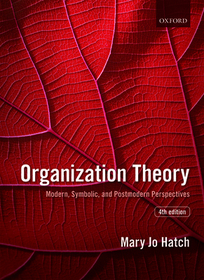
Organization Theory
Modern, Symbolic, and Postmodern Perspectives
- Publisher's listprice GBP 74.99
-
33 857 Ft (32 245 Ft + 5% VAT)
The price is estimated because at the time of ordering we do not know what conversion rates will apply to HUF / product currency when the book arrives. In case HUF is weaker, the price increases slightly, in case HUF is stronger, the price goes lower slightly.
- Discount 10% (cc. 3 385 Ft off)
- Discounted price 30 472 Ft (29 021 Ft + 5% VAT)
Subcribe now and take benefit of a favourable price.
Subscribe
33 857 Ft

Availability
printed on demand
Why don't you give exact delivery time?
Delivery time is estimated on our previous experiences. We give estimations only, because we order from outside Hungary, and the delivery time mainly depends on how quickly the publisher supplies the book. Faster or slower deliveries both happen, but we do our best to supply as quickly as possible.
Product details:
- Edition number 4
- Publisher OUP Oxford
- Date of Publication 15 March 2018
- ISBN 9780198723981
- Binding Paperback
- No. of pages436 pages
- Size 247x189x21 mm
- Weight 744 g
- Language English 0
Categories
Short description:
The only textbook to use a three-perspective framework to explain, explore, and evaluate organizational theory in a distinctively engaging style.
MoreLong description:
Organization Theory offers a clear and comprehensive introduction to the study of organizations and organizing processes. Through the unique three-perspective approach, students are challenged to explain, explore, and evaluate organizational theory, drawing on their own experiences as well as the book's diverse practical examples.
The fourth edition includes a host of new learning features, which examine the practicality of theorizing and encourage students to broaden their intellectual reach. 'Theory to Practice' boxes and case studies highlight organizing processes in a range of settings, either through real-life, business examples or through exercises that encourage students to apply the theory to organizations they know or organizing experiences of their own. 'Think like a Theorist' and 'Exercise Those Perspectives' boxes then encourage students to actively theorize and evaluate, developing essential critical thinking skills and a greater understanding of the complex knowledge with which organization theorists grapple. By taking theory off the page, students can learn through doing and adopt a reflexive stance to the world around them.
Mary Jo Hatch draws on her extensive experience in the field to produce a trusted and accessible introduction to the subject that provides academic depth, engaging pedagogy, and a practical focus.
This book is accompanied by a collection of online resources:
For students:
Multiple-choice questions
For lecturers:
PowerPoint slides
Figures and tables from the book
Lecturers' guide
Additional case studies
The most useful introductory text on organization theory there is.
Table of Contents:
Part One: What is Organization Theory?
Organization theory and its multiple perspectives
A brief history of organization theory
Part Two: Core Concepts and Theories
Organization-environment relations
Organizational social structure
Organizational technology
Organizational culture
The physical structure of built space in organizations
Part Three: Themes and Applications
Power in and around organizations: Organizational politics, conflict, and control
Organizational identity at Carlsberg Group

