

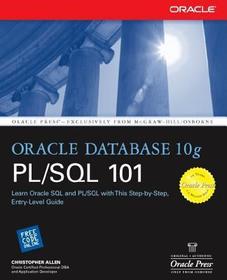
Oracle Database 10g PL/SQL 101
Learn Oracle SQL and PL/SQL with This Step-by-Step Entry-Level Guide
Series: Oracle Press;
- Publisher's listprice GBP 44.99
-
20 312 Ft (19 345 Ft + 5% VAT)
The price is estimated because at the time of ordering we do not know what conversion rates will apply to HUF / product currency when the book arrives. In case HUF is weaker, the price increases slightly, in case HUF is stronger, the price goes lower slightly.
- Discount 10% (cc. 2 031 Ft off)
- Discounted price 18 281 Ft (17 411 Ft + 5% VAT)
Subcribe now and take benefit of a favourable price.
Subscribe
20 312 Ft

Availability
Estimated delivery time: In stock at the publisher, but not at Prospero's office. Delivery time approx. 3-5 weeks.
Not in stock at Prospero.
Why don't you give exact delivery time?
Delivery time is estimated on our previous experiences. We give estimations only, because we order from outside Hungary, and the delivery time mainly depends on how quickly the publisher supplies the book. Faster or slower deliveries both happen, but we do our best to supply as quickly as possible.
Product details:
- Publisher McGraw Hill
- Date of Publication 16 September 2004
- ISBN 9780072255409
- Binding Paperback
- No. of pages395 pages
- Size 228x185x21 mm
- Weight 700 g
- Language English 0
Categories
Long description:
Publisher's Note: Products purchased from Third Party sellers are not guaranteed by the publisher for quality, authenticity, or access to any online entitlements included with the product.
Get The Ins-and-Outs of SQL and PL/SQL From an Oracle ExpertPerform database functions quickly and easily using the comprehensive information in this step-by-step guide. Oracle professional Christopher Allen begins with database basics and progresses to plain-language explanations and real-world examples of SQL statements and PL/SQL programs. You’ll learn how to manage, query, and manipulate data, use SQL*Plus, create SQL functions, and write practical PL/SQL applications. Review questions, chapter summaries, and hands-on projects will have you understanding and exploiting the powerful features of Oracle Database 10g in no time.
- Create tables, rows, records, columns, and fields
- Store text, numbers, dates, pictures, and soundfiles in tables and columns
- Define, manipulate, retrieve, and delete data, using SQL commands
- Select, sort, and filter records with SQL functions and procedures
- Write SQL commands to declare variables using anchored types
- Use SAVEPOINT and ROLLBACK commands to ensure multilevel undo
- Perform time-based and hierarchical data queries
- Edit and reuse commands in script files, using the SQL*Plus program
- Use PL/SQL views, sequences, procedures, functions, and packages
- Use triggers to automate auditing, security, and maintenance tasks
Publisher's Note: Products purchased from Third Party sellers are not guaranteed by the publisher for quality, authenticity, or access to any online entitlements included with the product.
Get The Ins-and-Outs of SQL and PL/SQL From an Oracle ExpertPerform database functions quickly and easily using the comprehensive information in this step-by-step guide. Oracle professional Christopher Allen begins with database basics and progresses to plain-language explanations and real-world examples of SQL statements and PL/SQL programs. You’ll learn how to manage, query, and manipulate data, use SQL*Plus, create SQL functions, and write practical PL/SQL applications. Review questions, chapter summaries, and hands-on projects will have you understanding and exploiting the powerful features of Oracle Database 10g in no time.
- Create tables, rows, records, columns, and fields
- Store text, numbers, dates, pictures, and soundfiles in tables and columns
- Define, manipulate, retrieve, and delete data, using SQL commands
- Select, sort, and filter records with SQL functions and procedures
- Write SQL commands to declare variables using anchored types
- Use SAVEPOINT and ROLLBACK commands to ensure multilevel undo
- Perform time-based and hierarchical data queries
- Edit and reuse commands in script files, using the SQL*Plus program
- Use PL/SQL views, sequences, procedures, functions, and packages
- Use triggers to automate auditing, security, and maintenance tasks

