

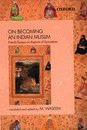
On Becoming an Indian Muslim
French Essays on Aspects of Syncretism
- Publisher's listprice GBP 25.00
-
11 287 Ft (10 750 Ft + 5% VAT)
The price is estimated because at the time of ordering we do not know what conversion rates will apply to HUF / product currency when the book arrives. In case HUF is weaker, the price increases slightly, in case HUF is stronger, the price goes lower slightly.
- Discount 10% (cc. 1 129 Ft off)
- Discounted price 10 159 Ft (9 675 Ft + 5% VAT)
Subcribe now and take benefit of a favourable price.
Subscribe
11 287 Ft

Availability
Out of print
Why don't you give exact delivery time?
Delivery time is estimated on our previous experiences. We give estimations only, because we order from outside Hungary, and the delivery time mainly depends on how quickly the publisher supplies the book. Faster or slower deliveries both happen, but we do our best to supply as quickly as possible.
Product details:
- Publisher Oxford University Press
- Date of Publication 3 April 2003
- ISBN 9780195658071
- Binding Hardback
- No. of pages370 pages
- Size 215x140x23 mm
- Weight 581 g
- Language English 0
Categories
Short description:
On Becoming an Indian Muslim is a collection of 14 essays translated from French on the various aspects of Indian Muslims, including their interactions with the Hindu world. They show an interesting yet little known 'regard' and sensitivity of the 20th Century scholarly community towards Islam in India
MoreLong description:
This selection of fifteen essays by modern French intellectuals in translation is a sequel to Garcin de Tassy's Muslim Festivals in India (first published in the 1830s) and translated by M. Waseem (OUP, 1995). The focus of this collection is religious syncretism: how at the popular level, when Islam first came to India, may un-Islamic elements derived from Hinduism (some even at variance with Islam's normative and canonical aspects) came to be accepted as part of the
practice of Islam on the subcontinent. Relying on literary and other texts as well as field studies, well-known French scholars -such as Louis Massignon, Jules Bloch, Jean Filliozat, Charlotte Vaudeville, Francoise Mallison, Denis Matringe, Marc Gaborieau, and Dominique-Sila Khan among others - trace the various
ways in which Islam found popular support at the grass-roots level in India. The essays focus on the significant contributions of the Indian mystic Kabir, Sufism, Dara Shikoh, Jayasi, Pir Shams, Waris Shah, Ghazi Miyan, 'Ramdeo' Pir, the Bhartrhari Jogis of Gorakhpur and Mahatama Gandhi. The concluding essay is by the translator himself and focuses on the followers of the Agha Khan, otherwise known as the Ismaili Khojas. M. Waseem's translation of all the essays is clear and precise, and his
substantive Introduction outlines the gradual amalgamation of different religious elements during the spread of Islam as described by these French intellectuals.
Table of Contents:
Introduction
Hinduism and Islamic Mysticism
HAUD AL HAYAT: The Arabic Version of Amratkund
Medieval Indian Mystics: Kabir
An Experiment in Hindu Muslim Unity: Dara Shikoh
Dara Shikoh's Intervie with Baba La'l Das at Lahore
Dara Shikoh's Samundrasangam
The Spiritual Significance of Gandhi's Last Pilgrimmage
The Concept of Divine Love in Jayasi: virah and ishq
Pir Shams and his garabi Song
Waris Shah
The Ghazi Miyan Cult in Western Nepal and Northern India
The Isma'ili Origin of the Hindu Cult of 'Ramdeo'Pir
The Muslim Bhartrhari Jogis of Gorakhpur
Towards a Sociology of Indian Muslims
Conclusion: A Note on the Isma'ili Khojas

