

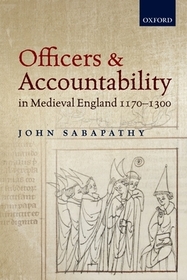
Officers and Accountability in Medieval England 1170-1300
- Publisher's listprice GBP 42.99
-
19 409 Ft (18 485 Ft + 5% VAT)
The price is estimated because at the time of ordering we do not know what conversion rates will apply to HUF / product currency when the book arrives. In case HUF is weaker, the price increases slightly, in case HUF is stronger, the price goes lower slightly.
- Discount 10% (cc. 1 941 Ft off)
- Discounted price 17 468 Ft (16 637 Ft + 5% VAT)
Subcribe now and take benefit of a favourable price.
Subscribe
19 409 Ft

Availability
printed on demand
Why don't you give exact delivery time?
Delivery time is estimated on our previous experiences. We give estimations only, because we order from outside Hungary, and the delivery time mainly depends on how quickly the publisher supplies the book. Faster or slower deliveries both happen, but we do our best to supply as quickly as possible.
Product details:
- Publisher OUP Oxford
- Date of Publication 13 September 2019
- ISBN 9780198847984
- Binding Paperback
- No. of pages336 pages
- Size 232x156x16 mm
- Weight 498 g
- Language English 0
Categories
Short description:
A volume which examines twelfth and thirteenth century officers and the practices used to regulate them in England, placing them not only within a British context but also a wider European one and exploring how administration, law, politics, and norms where used to control the insolence of office.
MoreLong description:
The later twelfth and thirteenth centuries were a pivotal period for the development of European government and governance. A mentality emerged that trusted to procedures of accountability as a means of controlling officers' conduct. The mentality was not inherently new, but it became qualitatively more complex and quantitatively more widespread in this period, across European countries, and across different sorts of officer. The officers exposed to these methods were not just 'state' ones, but also seignorial, ecclasistical, and university-college officers, as well as urban-communal ones. This study surveys these officers and the practices used to regulate them in England. It places them not only within a British context but also a wide European one and explores how administration, law, politics, and norms tried to control the insolence of office.
The devices for institutionalising accountability analysed here reflected an extraordinarily creative response in England, and beyond, to the problem of complex government: inquests, audits, accounts, scrutiny panels, sindication. Many of them have shaped the way in which we think about accountability today. Some remain with us. So too do their practical problems. How can one delegate control effectively? How does accountability relate to responsibility? What relationship does accountability have with justice? This study offers answers for these questions in the Middle Ages, and is the first of its kind dedicated to an examination of this important topic in this period.
a very elegant book
Table of Contents:
Introduction
Bailiffs and stewards
Sheriffs
Bishops
Wardens and Fellows
Conclusions
Select Bibliography

