

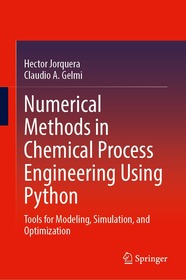
Numerical Methods in Chemical Process Engineering Using Python
Tools for Modeling, Simulation, and Optimization
- Publisher's listprice EUR 90.94
-
35 521 Ft (33 829 Ft + 5% VAT)
The price is estimated because at the time of ordering we do not know what conversion rates will apply to HUF / product currency when the book arrives. In case HUF is weaker, the price increases slightly, in case HUF is stronger, the price goes lower slightly.
- Discount 12% (cc. 4 263 Ft off)
- Discounted price 31 258 Ft (29 770 Ft + 5% VAT)
Subcribe now and take benefit of a favourable price.
Subscribe
31 258 Ft

Availability
Not yet published.
Why don't you give exact delivery time?
Delivery time is estimated on our previous experiences. We give estimations only, because we order from outside Hungary, and the delivery time mainly depends on how quickly the publisher supplies the book. Faster or slower deliveries both happen, but we do our best to supply as quickly as possible.
Product details:
- Publisher Springer Nature Switzerland
- Date of Publication 27 August 2026
- ISBN 9783032229571
- Binding Hardback
- No. of pages189 pages
- Size 235x155 mm
- Language English
- Illustrations IX, 189 p. 700
Categories
Long description:
"
This book provides an overview of the most widely used numerical methods in chemical process engineering organized by increasing levels of complexity.
The book begins with numerical linear algebra, which is essential for solving large systems of equations, and continues with nonlinear equations, a cornerstone for modeling equilibrium and reaction kinetics. Ordinary differential equations are then addressed, covering both initial value and boundary value problems, with an emphasis on their role in describing dynamic behavior and transport phenomena. The section concludes with partial differential equations, which are fundamental for capturing spatial and temporal variations in heat, mass, and momentum transfer.
The second part of the book presents a curated set of solved problems, each supported by Python code and figures. Covering topics such as parameter estimation, confidence intervals, and bioreactor optimization, the problems emphasize both steady-state and dynamic systems. Each example covers the deriving governing equations, related code, and interpreting results, providing a consistent learning path, while additional discussions encourage students to explore related concepts beyond the presented problem.
" MoreTable of Contents:
"
SYSTEMS OF LINEAR EQUATIONS.- NONLINEAR EQUATIONS.- ORDINARY DIFFERENTIAL EQUATIONS.- ORDINARY DIFFERENTIAL EQUATIONS BOUNDARY VALUE PROBLEMS.- PARTIAL DIFFERENTIAL EQUATIONS.- CASE STUDIES.
" More
