

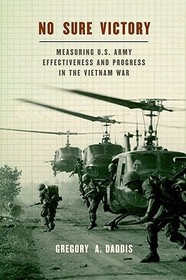
No Sure Victory
Measuring U.S. Army Effectiveness and Progress in the Vietnam War
- Publisher's listprice GBP 54.00
-
24 381 Ft (23 220 Ft + 5% VAT)
The price is estimated because at the time of ordering we do not know what conversion rates will apply to HUF / product currency when the book arrives. In case HUF is weaker, the price increases slightly, in case HUF is stronger, the price goes lower slightly.
- Discount 10% (cc. 2 438 Ft off)
- Discounted price 21 943 Ft (20 898 Ft + 5% VAT)
Subcribe now and take benefit of a favourable price.
Subscribe
24 381 Ft

Availability
printed on demand
Why don't you give exact delivery time?
Delivery time is estimated on our previous experiences. We give estimations only, because we order from outside Hungary, and the delivery time mainly depends on how quickly the publisher supplies the book. Faster or slower deliveries both happen, but we do our best to supply as quickly as possible.
Product details:
- Publisher OUP USA
- Date of Publication 9 June 2011
- ISBN 9780199746873
- Binding Hardback
- No. of pages368 pages
- Size 155x236x33 mm
- Weight 612 g
- Language English
- Illustrations 5 maps, 10 black and white photos 0
Categories
Short description:
Filled with incisive analysis and rich historical detail, No Sure Victory will be a valuable resource for Vietnam War historians and current military professionals alike. For students of military history, American history, and 20th-century political history, this book will provide a new take on the well-worn issue of determining the root cause of U.S. military failure in Vietnam. For the contemporary military or political official, No Sure Victory is a case study in unconventional warfare, a cautionary tale that will be an important guide to measuring performance in current and future armed conflict.
MoreLong description:
It is commonly thought that the U.S. Army in Vietnam, thrust into a war in which territory occupied was meaningless, depended on body counts as its sole measure of military progress. In No Sure Victory, Army officer and historian Gregory A. Daddis uncovers the truth behind this gross simplification of the historical record. Daddis shows that, confronted by an unfamiliar enemy and an even more unfamiliar form of warfare, the U.S. Army adopted a massive, and eventually unmanageable, system of measurements and formulas to track the progress of military operations that ranged from pacification efforts to search-and-destroy missions. Concentrating more on data collection and less on data analysis, these indiscriminate attempts to gauge success may actually have hindered the army's ability to evaluate the true outcome of the fight at hand--a roadblock that Daddis believes significantly contributed to the multitude of failures that American forces in Vietnam faced. Filled with incisive analysis and rich historical detail, No Sure Victory is a valuable case study in unconventional warfare, a cautionary tale that offers important perspectives on how to measure performance in current and future armed conflict.
This timely and important book is a major addition to the military history of the Vietnam War. It should be required reading for those grappling with the issues posed by counterinsurgency wars today.
Table of Contents:
Maps of Vietnam and Major Breakout Zones
Lists of Abbreviations
Introduction
Of Questions Not Asked
Measurements Without Objectives
An "Unprecedented Victory"
Metrics in the Year of American Firepower
"We are winning slowly but steadily"
The Year of Tet
"A Time for Testing"
Soldiers' Interlude
Staggering to the Finish
Conclusion
Bibliography
Index

