

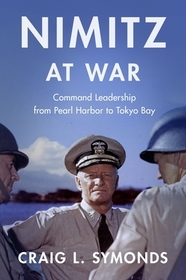
Nimitz at War
Command Leadership from Pearl Harbor to Tokyo Bay
- Publisher's listprice GBP 28.49
-
12 863 Ft (12 250 Ft + 5% VAT)
The price is estimated because at the time of ordering we do not know what conversion rates will apply to HUF / product currency when the book arrives. In case HUF is weaker, the price increases slightly, in case HUF is stronger, the price goes lower slightly.
- Discount 20% (cc. 2 573 Ft off)
- Discounted price 10 290 Ft (9 800 Ft + 5% VAT)
- Discount is valid until: 30 June 2026
Subcribe now and take benefit of a favourable price.
Subscribe
12 863 Ft

Availability
Estimated delivery time: In stock at the publisher, but not at Prospero's office. Delivery time approx. 3-5 weeks.
Not in stock at Prospero.
Why don't you give exact delivery time?
Delivery time is estimated on our previous experiences. We give estimations only, because we order from outside Hungary, and the delivery time mainly depends on how quickly the publisher supplies the book. Faster or slower deliveries both happen, but we do our best to supply as quickly as possible.
Product details:
- Publisher OUP USA
- Date of Publication 13 October 2022
- ISBN 9780190062361
- Binding Hardback
- No. of pages496 pages
- Size 243x161x31 mm
- Weight 844 g
- Language English 245
Categories
Short description:
This wartime biography of the Chester W. Nimitz, Commander-in-Chief of U.S. forces in the Pacific Ocean Area during World War II, gives a bird's eye view of the war from inside the theater headquarters of the man most responsible for eventual victory against Japan.
MoreLong description:
From America's preeminent naval historian, the first full-length portrait in over fifty years of the man who won the war in the Pacific in World War Two—"destined," says Andrew Roberts, "to be the defining life of Chester Nimitz for a long time to come."
Only days after the Japanese attacked Pearl Harbor, President Franklin D. Roosevelt tapped Chester W. Nimitz to assume command of the Pacific Fleet. Nimitz was not the most senior candidate available, and some, including his new boss, U.S. Navy Admiral Ernest J. King, considered him a "desk admiral," more suited to running a bureaucracy than a theater of war. Yet FDR's selection proved nothing less than inspired. From the precarious early months of the war after December 7th 1941 to the surrender ceremony in Tokyo Bay nearly four years later, Nimitz transformed the devastated and dispirited Pacific fleet into the most powerful and commanding naval force in history.
From the start, the pressures on Nimitz were crushing. Facing demands from Washington to mount an early offensive, he had first to revive the depressed morale of the thousands of sailors, soldiers, and Marines who served under him. He had to corral independent-minded subordinates—including Admiral Bill "Bull" Halsey and General Holland "Howlin' Mad" Smith—and keep them focused on shared objectives. He had to maintain a sometimes-fraught relationship with his Army counterpart Douglas MacArthur, and cope with his superiors, including the formidably prickly King and the inscrutable FDR. He had to navigate the expectations of a nation impatient for revenge and eventual victory. And of course, he also confronted a formidable and implacable enemy in the Imperial Japanese Navy, which, until the Battle of Midway, had the run of the Pacific.
Craig Symonds' Nimitz at War reveals how the quiet man from the Hill Country of Texas eventually surmounted all of these challenges. Using Nimitz's headquarters—the eye of the hurricane—as his vantage point, Symonds covers all the major campaigns in the Pacific from Guadalcanal to Okinawa. He captures Nimitz's composure, discipline, homespun wisdom, and most of all his uncanny sense of when to assert authority and when to pull back. In retrospect it is difficult to imagine anyone else accomplishing what Nimitz did. As Symonds' absorbing, dynamic, and authoritative portrait reveals, it required qualities of leadership exhibited by few other commanders in history, qualities that are enduringly and even poignantly relevant to our own moment.
In December 1941, FDR's choice to take over the shattered US Pacific Fleet was an obscure desk admiral. His selection proved inspired beyond all expectation. Within six months, Nimitz helped set the stage for the ultimate defeat of Japan, holding his own with his superiors while quietly fashioning an outstanding set of subordinate commanders. Symonds has given us a Nimitz for the 21st Century.
Table of Contents:
Prologue
I. Taking Command
II. The South Pacific
III. The Central Pacific Drive
IV. Victory
Acknowledgments
Notes
Bibliography

