

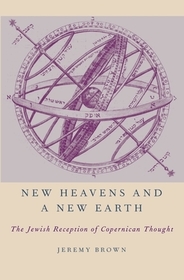
New Heavens and a New Earth
The Jewish Reception of Copernican Thought
- Publisher's listprice GBP 29.99
-
13 540 Ft (12 895 Ft + 5% VAT)
The price is estimated because at the time of ordering we do not know what conversion rates will apply to HUF / product currency when the book arrives. In case HUF is weaker, the price increases slightly, in case HUF is stronger, the price goes lower slightly.
- Discount 20% (cc. 2 708 Ft off)
- Discounted price 10 832 Ft (10 316 Ft + 5% VAT)
- Discount is valid until: 30 June 2026
Subcribe now and take benefit of a favourable price.
Subscribe
13 540 Ft

Availability
Estimated delivery time: In stock at the publisher, but not at Prospero's office. Delivery time approx. 3-5 weeks.
Not in stock at Prospero.
Why don't you give exact delivery time?
Delivery time is estimated on our previous experiences. We give estimations only, because we order from outside Hungary, and the delivery time mainly depends on how quickly the publisher supplies the book. Faster or slower deliveries both happen, but we do our best to supply as quickly as possible.
Product details:
- Publisher OUP USA
- Date of Publication 29 September 2021
- ISBN 9780197584330
- Binding Paperback
- No. of pages416 pages
- Size 160x239x30 mm
- Weight 794 g
- Language English
- Illustrations 26 illus. 141
Categories
Short description:
Jeremy Brown offers the first major study of the Jewish reception of the Copernican revolution, examining four hundred years of Jewish writings on the Copernican model. Brown shows the ways in which Jews ignored, rejected, or accepted the Copernican model, and the theological and societal underpinnings of their choices.
MoreLong description:
In this ground-breaking study of the Jewish reception of the Copernican revolution, Jeremy Brown examines four hundred years of Jewish writings on the Copernican model. Brown shows the ways in which Jews ignored, rejected, or accepted the Copernican model, and the theological and societal underpinnings of their choices.
Throughout New Heavens and a New Earth are deft historical studies of such colorful figures as Joseph Delmedigo, the first Jewish Copernican and a student of Galileo; Tuviah Cohen, who called Copernicus the "Son of Satan;" Zelig Slonimski, author of a collection of essays on Halley's Comet; and contemporary Jewish thinkers who use Einstein's Theory of Relativity to argue that the Earth does not actually revolve around the sun. Brown also provides insightful comparisons of concurrent Jewish and Christian writings on Copernicus, demonstrating that the Jewish reception of Copernicus was largely dependent on local factors and responses.
Table of Contents:
Introduction
Chapter 1 - Nicolas Copernicus and His Revolution
Chapter 2 - The Talmudic View of the Universe
Chapter 3 - David Gans and the First Mention of Copernicus in Hebrew Literature
Chapter 4 - The First Jewish Copernican: Rabbi Joseph Solomon Delmedigo
Chapter 5 - ''Copernicus Is the Son of Satan.'' The First Jewish Rejections of Copernicus
Chapter 6 - David Nieto and Copernicanism in London
Chapter 7 - The Jewish Encyclopedias
Chapter 8 - The Eighteenth Century. Jews and Copernicus in the Newtonian Era
Chapter 9 - ''I Have Written a Book For the Young People.'' David Friesenhausen's Mosdot Tevel
Chapter 10 - The Nineteenth Century: Copernicus Without Hesitation
Chapter 11 - ''Let Copernicus and a Thousand Like Him Be Removed From the World.'' Reuven Landau's Rejection
Chapter 12 - The Modern Period
Chapter 13 - Relativity and Contemporary Jewish Geocentrists
Chapter 14 - Conclusions
Appendix
Bibliography

