

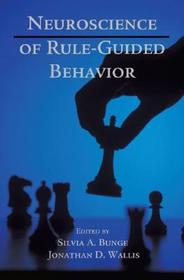
Neuroscience of Rule-Guided Behavior
- Publisher's listprice GBP 105.00
-
47 407 Ft (45 150 Ft + 5% VAT)
The price is estimated because at the time of ordering we do not know what conversion rates will apply to HUF / product currency when the book arrives. In case HUF is weaker, the price increases slightly, in case HUF is stronger, the price goes lower slightly.
- Discount 10% (cc. 4 740 Ft off)
- Discounted price 42 667 Ft (40 635 Ft + 5% VAT)
Subcribe now and take benefit of a favourable price.
Subscribe
47 407 Ft

Availability
printed on demand
Why don't you give exact delivery time?
Delivery time is estimated on our previous experiences. We give estimations only, because we order from outside Hungary, and the delivery time mainly depends on how quickly the publisher supplies the book. Faster or slower deliveries both happen, but we do our best to supply as quickly as possible.
Product details:
- Publisher OUP USA
- Date of Publication 11 October 2007
- ISBN 9780195314274
- Binding Hardback
- No. of pages512 pages
- Size 160x236x30 mm
- Weight 865 g
- Language English
- Illustrations 32 colour and 129 black and white illustrations 0
Categories
Short description:
Rules are central to human behaviour, but until now the field of neuroscience lacked a unified approach to understanding them. This book brings together the world's leading cognitive and systems neuroscientists to explain the most recent research on rule-guided behaviour.
MoreLong description:
Neuroscience of Rule-Guided Behavior brings together, for the first time, the experiments and theories that have created the new science of rules. Rules are central to human behavior, but until now the field of neuroscience lacked a synthetic approach to understanding them. How are rules learned, retrieved from memory, maintained in consciousness and implemented? How are they used to solve problems and select among actions and activities? How are the various levels of rules represented in the brain, ranging from simple conditional ones if a traffic light turns red, then stop to rules and strategies of such sophistication that they defy description? And how do brain regions interact to produce rule-guided behaviour? These are among the most fundamental questions facing neuroscience, but until recently there was relatively little progress in answering them. It was difficult to probe brain mechanisms in humans, and expert opinion held that animals lacked the capacity for such high-level behaviour. However, rapid progress in neuroimaging technology has allowed investigators to explore brain mechanisms in humans, while increasingly sophisticated behavioral methods have revealed that animals can and do use high-level rules to control their behavior. The resulting explosion of information has led to a new science of rules, but it has also produced a plethora of overlapping ideas and terminology and a field sorely in need of synthesis. In this book, Silvia Bunge and Jonathan Wallis bring together the worlds leading cognitive and systems neuroscientists to explain the most recent research on rule-guided behavior. Their work covers a wide range of disciplines and methods, including neuropsychology, functional magnetic resonance imaging, neurophysiology, electroencephalography, neuropharmacology, near-infrared spectroscopy, and transcranial magnetic stimulation. This unprecedented synthesis is a must-read for anyone interested in how complex behaviour is controlled and organized by the brain.
MoreTable of Contents:
Introduction
Part I: Rule Representation
Selection between Competing Responses based on Conditional Rules
Single Neuron Activity Underlying Behavior-Guiding Rules
Neural Representations Used to Specify Action a Silvia A Bunge and Michael J. Souza
Maintenance and Implementation of Task Rules
The Neurophysiology of Abstract Response Strategies
Abstraction of Mental Representations: Theoretical Considerations and Neuroscientific Evidence
Part II: Rule Implementation
Ventrolateral and Medial Frontal Contributions to Decision-Making and Action Selection
Differential Involvement of the Prefrontal, Premotor, and Primary Motor Cortices in Rule-Based Motor Behavior
The Role of the Posterior Frontolateral Cortex in Task-Related Control
Time Course of Executive Processes: Data from the Event-Related Optical Signal
Part III: Task-Switching
Task-Switching in Human and Non-Human Primates: Understanding Rule Encoding and Control from Behavior to Single Neurons
Neural Mechanisms of Cognitive Control in Task-Switching: Rules, Representations, and Preparation
Dopaminergic and Serotonergic Modulation of Two Distinct Forms of Flexible Cognitive Control: Attentional Set-Shifting and Reversal Learning
Dopaminergic Modulation of Flexible Cognitive Control: The Role of the Striatum
Part IV: Building Blocks of Rule Representation
Binding and Organization in the Medical Temporal Lobe
Ventrolateral Prefrontal Cortex and Controlling Memory to Inform Action
Exploring the Roles of the Frontal, Temporal, and Parietal Lobes in Visual Categorization
Rules through Recursion: How Interactions Between the Frontal Cortex and Basal Ganglia may Build Abstract Rules from Concrete, Simple Ones
The Development of Rule Use in Childhood

