

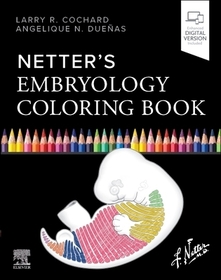
Netter's Embryology Coloring Book
Series: Netter Basic Science;
- Publisher's listprice EUR 20.99
-
8 198 Ft (7 808 Ft + 5% VAT)
The price is estimated because at the time of ordering we do not know what conversion rates will apply to HUF / product currency when the book arrives. In case HUF is weaker, the price increases slightly, in case HUF is stronger, the price goes lower slightly.
- Discount 20% (cc. 1 640 Ft off)
- Discounted price 6 559 Ft (6 246 Ft + 5% VAT)
- Discount is valid until: 30 June 2026
Subcribe now and take benefit of a favourable price.
Subscribe
8 198 Ft

Availability
Not yet published.
Why don't you give exact delivery time?
Delivery time is estimated on our previous experiences. We give estimations only, because we order from outside Hungary, and the delivery time mainly depends on how quickly the publisher supplies the book. Faster or slower deliveries both happen, but we do our best to supply as quickly as possible.
Product details:
- Publisher Elsevier Health Sciences
- Date of Publication 8 June 2026
- ISBN 9780443379154
- Binding Paperback
- No. of pages pages
- Weight 450 g
- Language English 700
Categories
Long description:
An all-new addition to the Netter Coloring Books family, Netter’s Embryology Coloring Book makes learning embryology easier and more enjoyable through active and engaging review! The study of embryology is particularly suited for coloring exercises because the actions of coloring and tracing reinforce spatial understanding and changes following the development of structures over time. With artwork based on the highly regarded and familiar Netter collection, you know you’re benefiting from reliable, up-to-date anatomical information. This new Netter coloring book also contains review questions and clinical notes, making it an excellent, high-yield embryology resource for foundational learning as well as review.
Netter's Embryology Coloring Book is a perfect companion to Netter’s Anatomy Coloring Book as well as Netter’s Atlas of Human Embryology, Netter’s Physiology Coloring Book, Netter’s Neuroscience Coloring Book, Netter’s Anatomy Flash Cards, and Netter’s Physiology Flash Cards.
- Emphasizes the continuity between the primordia (precursors) in the early embryo and their derivatives in the fetus and adult
- Uses standard color coding for the three early embryo (gastrula) germ layers of cells: ectoderm blue, endoderm yellow, and mesoderm red reflect common conventions used in life sciences education
- Features Clinical Notes throughout that emphasize important aspects of development in a clinical context
- Includes review questions at the end of each section for convenient self-assessment and review
- Presents each topic in two-page spreads?with outlines of Netter anatomical illustrations for coloring on one side; and high-yield information and coloring guide on the other
- Features illustrations small enough for quick coloring, but large enough to provide important details
- Offers tips for coloring key structures that emphasize how a coloring exercise can reinforce learning
- Provides online access where you can view completed coloring pages for reference
- An eBook version is included with purchase. The eBook allows you to access all of the text and figures, with the ability to search, make notes and highlights, and have content read aloud
Table of Contents:
1. Overview of developmental events, processes and anomalies timeline: The prenatal time scale (months) the first and second weeks
2. Early embryonic development and the placenta adult uterus, ovaries, and uterine tube
3. The nervous system formation of the neural plate
4. The cardiovascular system early vascular systems
5. The respiratory system early primordia formation of the pleural cavities visceral and parietal pleura development of the diaphragm
6. The gastrointestinal system and abdominal wall formation of the gut tube and mesenteries foregut, midgut, and hindgut
7. The urogenital system early primordia division of the cloaca
8. The musculoskeletal system myotomes, dermatomes, and sclerotomes muscle and vertebral column segmentation mesenchymal primordia at five and six weeks
9. Head and neck ectoderm, endoderm and mesoderm

