

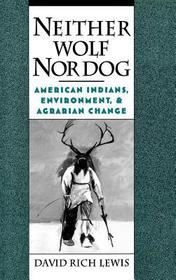
Neither Wolf Nor Dog
American Indians, Environment, and Agrarian Change
- Publisher's listprice GBP 33.49
-
15 999 Ft (15 237 Ft + 5% VAT)
The price is estimated because at the time of ordering we do not know what conversion rates will apply to HUF / product currency when the book arrives. In case HUF is weaker, the price increases slightly, in case HUF is stronger, the price goes lower slightly.
- Discount 10% (cc. 1 600 Ft off)
- Discounted price 14 399 Ft (13 713 Ft + 5% VAT)
Subcribe now and take benefit of a favourable price.
Subscribe
15 999 Ft

Availability
printed on demand
Why don't you give exact delivery time?
Delivery time is estimated on our previous experiences. We give estimations only, because we order from outside Hungary, and the delivery time mainly depends on how quickly the publisher supplies the book. Faster or slower deliveries both happen, but we do our best to supply as quickly as possible.
Product details:
- Publisher OUP USA
- Date of Publication 12 January 1995
- ISBN 9780195062977
- Binding Hardback
- No. of pages256 pages
- Size 237x161x20 mm
- Weight 544 g
- Language English
- Illustrations halftones, line drawings 0
Categories
Short description:
The book focuses on three diverse Native American groups, the Northern Ute, Hupa, and Papago - and in particular explores the ways in which these peoples responded to social, subsistence, and environmental changes entailed by settled reservations and allotted agriculture, and how this helps to reveal how American Indians in general responded to these cultural changes. Lewis tells the story not of a past civilization, but one that has adapted and evolved and continues to do so this day.
MoreLong description:
During the nineteenth century, Americans looked to the eventual civilization and assimilation of Native Americans through a process of removal, reservation, and directed culture change. Policies for directed subsistence change and incorporation had far-reaching social and environmental consequences for native peoples and native lands. This study explores the experiences of three groups--Northern Utes, Hupas, and Tohono O'odhams--with settled reservation and allotted agriculture in the nineteenth and twentieth centuries. Each group inhabited a different environment, and their cultural traditions reflected distinct subsistence adaptations to life in the western United States. Each experienced the full weight of federal agrarian policy yet responded differently, in culturally consistent ways, to subsistence change and the resulting social and environmental consequences. Attempts to establish successful agricultural economies ultimately failed as each group reproduced their own cultural values in a diminished and rapidly changing environment. In the end, such policies and agrarian experiences left Indian farmers marginally incorporated and economically dependent.
Lewis is dealing with the more complex and academically challenging aftermath of conquest...This is precisely this finely nuanced and sensitive book's strength and appeal.

