

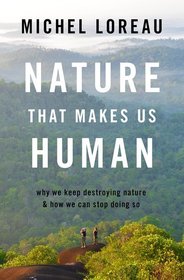
Nature That Makes Us Human
Why We Keep Destroying Nature and How We Can Stop Doing So
- Publisher's listprice GBP 25.49
-
11 508 Ft (10 960 Ft + 5% VAT)
The price is estimated because at the time of ordering we do not know what conversion rates will apply to HUF / product currency when the book arrives. In case HUF is weaker, the price increases slightly, in case HUF is stronger, the price goes lower slightly.
- Discount 10% (cc. 1 151 Ft off)
- Discounted price 10 357 Ft (9 864 Ft + 5% VAT)
Subcribe now and take benefit of a favourable price.
Subscribe
11 508 Ft

Availability
Estimated delivery time: In stock at the publisher, but not at Prospero's office. Delivery time approx. 3-5 weeks.
Not in stock at Prospero.
Why don't you give exact delivery time?
Delivery time is estimated on our previous experiences. We give estimations only, because we order from outside Hungary, and the delivery time mainly depends on how quickly the publisher supplies the book. Faster or slower deliveries both happen, but we do our best to supply as quickly as possible.
Product details:
- Publisher OUP USA
- Date of Publication 2 June 2023
- ISBN 9780197628430
- Binding Hardback
- No. of pages168 pages
- Size 237x163x19 mm
- Weight 390 g
- Language English
- Illustrations 11 B&W illustrations 408
Categories
Short description:
Nature That Makes Us Human combines recent scientific discoveries in biology and psychology with deep philosophical inquiry--in addition to economic, political, and historical considerations--to understand what motivates us to keep destroying nature today and how we can engage in a new relationship with nature tomorrow. This book is for anyone interested in understanding and overcoming the current ecological crisis.
MoreLong description:
Climate change, biodiversity loss, pollution, resource depletion, new emerging diseases: scientists have raised awareness on the ecological and societal consequences of the unbridled development of human activities for a long time. Why do we keep destroying nature when science makes it clear that in doing so we risk our own destruction? How can we stop destroying our life-support system and reach some kind of harmony between humans and nature?
This book seeks to answer these questions. It describes the inability of modern society to fundamentally modify its relationship with nature, instead engaging in collective fictions such as subject-object duality, matter-mind duality, the primacy of rationality, and the superiority of the human species over all other life. Subsequent chapters identify avenues which could allow human societies to break the current deadlock and forge a relationship with the natural world. This path is rooted in a simple observation: humans have a nature that defines them as a unique species beyond their cultural differences, and at the foundation of this nature we share a set of fundamental needs. The expression and satisfaction of these needs provide an opportunity to reconnect humans with nature in all its forms.
Nature That Makes Us Human combines recent scientific discoveries in biology and psychology with deep philosophical inquiry--in addition to economic, political, and historical considerations--to understand what motivates us to keep destroying nature today and how we can engage in a new relationship with nature tomorrow. This book is for anyone interested in understanding and overcoming the current ecological crisis.
Table of Contents:
Introduction
Part one. Humans versus nature
Chapter 1. Homo sapiens, a species among many others but not quite like the others
Chapter 2. A brief history of the divorce between humans and nature
Chapter 3. Subject and object: The mirror of modernity
Chapter 4. Matter and spirit: The great illusion
Chapter 5. The underside of economic rationality and progress
Chapter 6. Journey to the centre of the modern world
Part two. Where humans and nature are one
Chapter 7. Letting nature touch us
Chapter 8. Recovering nature in us through our fundamental needs
Chapter 9. Reunifying knowledge of body and mind
Chapter 10. Building a social and economic order that serves life
Chapter 11. Embracing life that flows through us
References

