

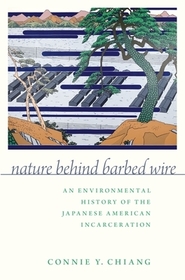
Nature Behind Barbed Wire
An Environmental History of the Japanese American Incarceration
- Publisher's listprice GBP 27.49
-
13 133 Ft (12 507 Ft + 5% VAT)
The price is estimated because at the time of ordering we do not know what conversion rates will apply to HUF / product currency when the book arrives. In case HUF is weaker, the price increases slightly, in case HUF is stronger, the price goes lower slightly.
- Discount 10% (cc. 1 313 Ft off)
- Discounted price 11 819 Ft (11 256 Ft + 5% VAT)
Subcribe now and take benefit of a favourable price.
Subscribe
13 133 Ft

Availability
Estimated delivery time: In stock at the publisher, but not at Prospero's office. Delivery time approx. 3-5 weeks.
Not in stock at Prospero.
Why don't you give exact delivery time?
Delivery time is estimated on our previous experiences. We give estimations only, because we order from outside Hungary, and the delivery time mainly depends on how quickly the publisher supplies the book. Faster or slower deliveries both happen, but we do our best to supply as quickly as possible.
Product details:
- Publisher OUP USA
- Date of Publication 22 September 2020
- ISBN 9780197533567
- Binding Paperback
- No. of pages330 pages
- Size 234x157x17 mm
- Weight 476 g
- Language English
- Illustrations 34 halftones 56
Categories
Short description:
Nature Behind Barbed Wire uses an environmental lens to reinterpret the forced removal and confinement of Japanese Americans during World War II.
MoreLong description:
The mass imprisonment of over 110,000 people of Japanese ancestry during World War II was one of the most egregious violations of civil liberties in United States history. Removed from their homes on the temperate Pacific Coast, Japanese Americans spent the war years in desolate camps in the nation's interior. Photographers including Ansel Adams and Dorothea Lange visually captured these camps in images that depicted the environment as a source of both hope and hardship. And yet the literature on incarceration has most often focused on the legal and citizenship statuses of the incarcerees, their political struggles with the US government, and their oral testimony.
Nature Behind Barbed Wire shifts the focus to the environment. It explores how the landscape shaped the experiences of both Japanese Americans and federal officials who worked for the War Relocation Authority (WRA), the civilian agency that administered the camps. The complexities of the natural world both enhanced and constrained the WRA's power and provided Japanese Americans with opportunities to redefine the terms and conditions of their confinement. Even as the environment compounded their feelings of despair and outrage, the incarcerees also found that their agency in transforming and adapting to the natural world could help them survive and contest their incarceration. Japanese Americans and WRA officials negotiated the terms of confinement with each other and with a dynamic natural world.
Ultimately, as Connie Chiang demonstrates, the Japanese American incarceration was fundamentally an environmental story.
A superb explication of the power of place.... Chiang argues the confinement of 120,000 internees is an environmental story as much as a social, legal, or political one.... Nature behind Barbed Wire is vital scholarship because it places the incarceration of Japanese Americans in the arena of social geography and environmental history.
Table of Contents:
Acknowledgments
Note on Terminology
Introduction: The Nature of Confinement
Chapter 1: Removal and Displacement
Chapter 2: Choosing Sites, Building Camps
Chapter 3: Maintaining the Camps
Chapter 4: Desert Agriculture
Chapter 5: Environmental Patriotism
Chapter 6: Outdoor Recreation
Chapter 7: Dispersal, Resettlement, Return
Epilogue: Emanating from the Soil
Notes
Selected Bibliography
Index

