

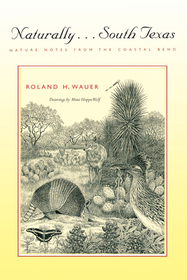
Naturally . . . South Texas
Nature Notes from the Coastal Bend
Series: Corrie Herring Hooks Series; 48;
- Publisher's listprice GBP 18.99
-
8 573 Ft (8 165 Ft + 5% VAT)
The price is estimated because at the time of ordering we do not know what conversion rates will apply to HUF / product currency when the book arrives. In case HUF is weaker, the price increases slightly, in case HUF is stronger, the price goes lower slightly.
- Discount 20% (cc. 1 715 Ft off)
- Discounted price 6 859 Ft (6 532 Ft + 5% VAT)
- Discount is valid until: 30 June 2026
Subcribe now and take benefit of a favourable price.
Subscribe
8 573 Ft

Availability
printed on demand
Why don't you give exact delivery time?
Delivery time is estimated on our previous experiences. We give estimations only, because we order from outside Hungary, and the delivery time mainly depends on how quickly the publisher supplies the book. Faster or slower deliveries both happen, but we do our best to supply as quickly as possible.
Product details:
- Publisher University of Texas Press
- Date of Publication 1 August 2001
- Number of Volumes Paperback
- ISBN 9780292791398
- Binding Paperback
- No. of pages256 pages
- Size 229x152 mm
- Weight 454 g
- Language English
- Illustrations 29 b&w illus. 0
Categories
Long description:
"
The Golden Crescent of South Texas, a fifteen-county region along and inland from the middle Gulf Coast, is often called ""the Crossroads"" because of its natural diversity. Located in the heart of the Gulf Coast Prairie and Marshes, the area also encompasses the trailing edges of the South Texas Plains, Post Oak Savannah, and Blackland Prairie. This confluence of ecological zones makes it a wonderful place for birding and for observing the changing face of nature, especially during seasonal transitions.
In this book, Ro Wauer describes a typical year in the natural life of South Texas. Using selected entries from his weekly column in the Victoria Advocate newspaper, he discusses numerous topics for each month, from the first appearance of butterflies in January, to alligators making a comeback in July, to the Christmas bird count in December. His observations are filled with intriguing natural history lore, from what sounds mockingbirds will imitate (almost any noise in their neighborhood) to how armadillos swim (by inflating themselves to increase their buoyancy).
" MoreTable of Contents:
- Introduction
- Natural History Calendar
- January
- February
- March
- April
- May
- June
- July
- August
- September
- October
- November
- December
- Index

