

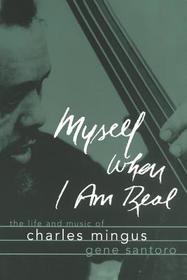
Myself When I Am Real
The Life and Music of Charles Mingus
- Publisher's listprice GBP 17.49
-
7 896 Ft (7 520 Ft + 5% VAT)
The price is estimated because at the time of ordering we do not know what conversion rates will apply to HUF / product currency when the book arrives. In case HUF is weaker, the price increases slightly, in case HUF is stronger, the price goes lower slightly.
- Discount 10% (cc. 790 Ft off)
- Discounted price 7 106 Ft (6 768 Ft + 5% VAT)
Subcribe now and take benefit of a favourable price.
Subscribe
7 896 Ft

Availability
printed on demand
Why don't you give exact delivery time?
Delivery time is estimated on our previous experiences. We give estimations only, because we order from outside Hungary, and the delivery time mainly depends on how quickly the publisher supplies the book. Faster or slower deliveries both happen, but we do our best to supply as quickly as possible.
Product details:
- Publisher OUP USA
- Date of Publication 21 February 2002
- ISBN 9780195147117
- Binding Paperback
- No. of pages480 pages
- Size 230x155x34 mm
- Weight 708 g
- Language English
- Illustrations 29 halftones 0
Categories
Short description:
Charles Mingus was one of the most innovative jazz musicians of the 20th century. This new biography by the acclaimed music critic Gene Santoro argues that Mingus was not only a great musician and composer but a central character in the postwar American cultural renaissance.
MoreLong description:
A pioneering bassist and composer, Mingus redefined jazz's terrain. He penned over 300 works spannig gutbucket gospel, Colombian cumbias, orchestral tone poems, multimedia performance, and chamber jazz. By the time he was 35, his growing body of music won increasing attention as it unfolded into one pioneering musical venture after another, from classical-meets-jazz extended pieces to spoken-word and dramatic performances and television and movie soundtracks.
But Mingus got headlines less for his art than for his volatile and often provocative behaviour, which drew fans who wanted to watch his temper suddenly flare onstage. Keeping up with the organized chaos of Mingus's art demanded gymnastic improvisational skills and openness from his musicians, which is why some of them called it "the Sweatshop". He hired and fired musicians on the bandstand, attacked a few musicians physically and many more verbally, twice threw Lionel Hampton's drummer off the stage, and routinely harangued chattering audiences, once chasing a table of inattentive patrons out of the FIVE SPOT with a meat cleaver. But the musical and mental challenges this volcanic man set his bands also nurtured deep loyalties. Jey sidemen stayed with him for years and even decades.
In this biography, Santoro probes the sore spots in Mingus's easily wounded nature that helped make him so explosive: his bullying father, his interracila background, his vulnerability to women and distrust of men, his views of political and social issues, his overwhelming need for love and acceptance. Of black, white, and Asian decent, Mingus made race a central issue in his life as well as a crucial aspect of his music, becoming an outspoken (and often misunderstood) critic of racila injustice. Santoro gives us a vivid portrait of Mingus's development, from the racially mixed Watts where he mingled with artists and writers as well as mobsters, union toughs, and pimps to the artistic ferment of postwar Greenwich Village, where he absorbed and extended the radical improvistation flowing through the work of Allen Ginsbert, Jackson Pollock, and Charlie Parker. Indeed, unlike most jazz biographers, Santoro examines Mingus's etra-musical influences - from Orson Welles to Langston Hughes, Farwell Taylor, and Timothy Leary - and illuminates his achievement in the broader cultural context it demands. Written in a lively, novelistic style, "Myself When I Am Real" draws on dozens of new interviews and previously untapped letters and archival materials to explore the intricate connections between this extraordinary man and the extraordinary music he made.
Review from previous edition Physically bearish and imposing, Mingus always seemed even larger psychically, a figure to fill the room, alter the vibes, suck up all the air - a cross between Falstaff and Othello. In his marvellous hall of mirrors, Myself When I Am real, Gene Santoro has grasped him whole, or at least as whole as one can expect from mere prose. Some passages suggest the hammering rhythms of a drum solo, others the sprawl of a Mingusian piano meditation. It is a stunning achievement.
Table of Contents:
Preface
Introduction
Prologue: Better Get It In Your Soul
Growing Up Absurd
Black Like Me
Making the Scene
Life During Wartime
Portrait of the Artist
The Big Apple, or On the Road
Pithecanthropus Erectus
Mingus Dynasty
Camelot
The Black Saint and the Sinner Lady
One Flew over the Cuckoo's Nest
Beneath the Underdog
Let My Children Hear Music
Changes
Don't Be Afraid, the Clown's Afraid, Too
Notes
Bibliography
Discography
Acknowledgements
Index

