

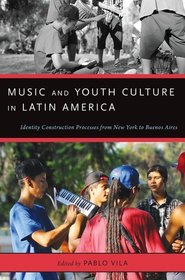
Music and Youth Culture in Latin America
Identity Construction Processes from New York to Buenos Aires
Series: Currents in Latin American and Iberian Music;
- Publisher's listprice GBP 31.49
-
14 217 Ft (13 540 Ft + 5% VAT)
The price is estimated because at the time of ordering we do not know what conversion rates will apply to HUF / product currency when the book arrives. In case HUF is weaker, the price increases slightly, in case HUF is stronger, the price goes lower slightly.
- Discount 20% (cc. 2 843 Ft off)
- Discounted price 11 374 Ft (10 832 Ft + 5% VAT)
- Discount is valid until: 30 June 2026
Subcribe now and take benefit of a favourable price.
Subscribe
14 217 Ft

Availability
Estimated delivery time: In stock at the publisher, but not at Prospero's office. Delivery time approx. 3-5 weeks.
Not in stock at Prospero.
Why don't you give exact delivery time?
Delivery time is estimated on our previous experiences. We give estimations only, because we order from outside Hungary, and the delivery time mainly depends on how quickly the publisher supplies the book. Faster or slower deliveries both happen, but we do our best to supply as quickly as possible.
Product details:
- Publisher OUP USA
- Date of Publication 20 November 2014
- ISBN 9780199986286
- Binding Paperback
- No. of pages304 pages
- Size 161x235x20 mm
- Weight 399 g
- Language English
- Illustrations 6 figures, 2 tables 0
Categories
Short description:
This book examines the ways in which music is used to advance identity claims in several Latin American countries and among Latinos in the US. Drawing on a vast array of fields including popular music studies, ethnomusicology, sociology, and history it sheds new light on the complex ways in which music provides people from different countries and social sectors with both enjoyment and tools for understanding who they are in terms of nationality, region, race, ethnicity, class, gender, and migration status.
MoreLong description:
Music is one of the most distinctive cultural characteristics of Latin American countries. But, while many people in the United States and Europe are familiar with musical genres such as salsa, merengue, and reggaeton, the musical manifestations that young people listen to in most Latin American countries are much more varied than these commercially successful ones that have entered the American and European markets. Not only that, the young people themselves often have little in common with the stereotypical image of them that exists in the American imagination.
Bridging this divide between perception and reality, Music and Youth Culture in Latin America brings together contributors from throughout Latin America and the US to examine the ways in which music is used to advance identity claims in several Latin American countries and among Latinos in the US. From young Latin American musicians who want to participate in the vibrant jazz scene of New York without losing their cultural roots, to Peruvian rockers who sing in their native language (Quechua) for the same reasons, to the young Cubans who use music to construct a post-communist social identification, this volume sheds new light on the complex ways in which music provides people from different countries and social sectors with both enjoyment and tools for understanding who they are in terms of nationality, region, race, ethnicity, class, gender, and migration status. Drawing on a vast array of fields including popular music studies, ethnomusicology, sociology, and history, Music and Youth Culture in Latin America is an illuminating read for anyone interested in Latin American music, culture, and society.
Table of Contents:
Acknowledgements
Introduction
Pablo Vila
Chapter 1: Narrative Identities and Popular Music: Linguistic Discourses
and Social Practices
Pablo Vila
Chapter 2: Past Identity: Guillermo Klein, Miguel Zenon and the Future
of Jazz
Jairo Moreno
Chapter 03: Errant surfing. Music, YouTube, the role of the Web in
Youth Cultures
Rossana Reguillo
Chapter 04: Music and Post-Communist Subjectivities in Cuba
Ruben Lopez Cano
Chapter 05: On Whitening and other Disaffections: The
Impact of Tropipop on Colombia's Music Scene
Hector Fernandez L'Hoeste
Chapter 06: Fusion Rock Bands and the "New Peru " on Stage
Patricia Oliart
Chapter 07: Political activists, playboys and hippies: musical
movements and symbolic representations of Brazilian youth in the 1960s
Marcos Napolitano
Chapter 08: The Pro Tools Generation. Digital Culture, Liveness,
and the New Sincerity in Brazilian Popular Music
Frederick Moehn
Chapter 09: A Newer Tango Coming from the Past
Laura Cambra and Juan Raffo
Chapter 10: Life Trajectories and Dejuvenilization in Argentine
Rock
Adrian Pablo Fanjul

