

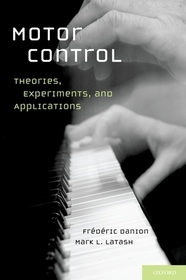
Motor Control
Theories, Experiments, and Applications
- Publisher's listprice GBP 127.50
-
57 566 Ft (54 825 Ft + 5% VAT)
The price is estimated because at the time of ordering we do not know what conversion rates will apply to HUF / product currency when the book arrives. In case HUF is weaker, the price increases slightly, in case HUF is stronger, the price goes lower slightly.
- Discount 10% (cc. 5 757 Ft off)
- Discounted price 51 810 Ft (49 343 Ft + 5% VAT)
Subcribe now and take benefit of a favourable price.
Subscribe
57 566 Ft

Availability
printed on demand
Why don't you give exact delivery time?
Delivery time is estimated on our previous experiences. We give estimations only, because we order from outside Hungary, and the delivery time mainly depends on how quickly the publisher supplies the book. Faster or slower deliveries both happen, but we do our best to supply as quickly as possible.
Product details:
- Publisher OUP USA
- Date of Publication 13 January 2011
- ISBN 9780195395273
- Binding Hardback
- No. of pages536 pages
- Size 163x236x33 mm
- Weight 885 g
- Language English
- Illustrations 163 illustrations 0
Categories
Short description:
The book focuses the recent developments in such areas as theories and models, neurophysiological, biomechanical, and behavioral studies, and applications to motor rehabilitation, prosthetics, and robotics. It offers a comprehensive coverage of the field of motor control with chapters written by established authorities in the field.
MoreLong description:
Motor control has established itself as an area of scientific research characterized by a multi-disciplinary approach. Scientists working in the area of control of voluntary movements come from different backgrounds including but not limited to physiology, physics, psychology, mathematics, neurology, physical therapy, computer science, robotics, and engineering. One of the factors slowing progress in the area has been the lack of communication among researchers representing all these disciplines. A major objective of the curreent book is to overcome this deficiency and to promote cooperation and mutual understanding among researchers addressing different aspects of the complex phenomenon of motor coordination. The book offers a collection of chapters written by the most prominent researchers in the field. Despite the variety of approaches and methods, all the chapters are united by a common goal: To understand how the central nervous system controls and coordinates natural voluntary movements. This book will be appreciated as a major reference by researchers working in all the subfields that form motor control. It can also be used as a supplementary reading book for graduate courses in such fields as kinesiology, physiology, biomechanics, psychology, robotics, and movement disorders.
In one concise volume, Motor Control presents the diversity of the research performed to understand human movement. Deftly organized into 6 primary sections, the editors, Dr Frédéric Danion and Dr Mark Latash, have invited the who's who of specialists to write on: MotorControl: Control of a Complex; Cortical Mechanisms of Motor Control; Lessons from Biomechanics; Lessons from Motor Learning and Using Tools; Lessons from Studies of Aging and MotorDisorders; and Lessons from Robotics
Motor Control will quickly become the go-to reference for researchers in this growing field. Researchers from mechanics and engineering to psychology and neurophysiology, as well as clinicians working in motor disorders and rehabilitation, will be equally interested in the pages contained herein.
Motor Control will quickly become the go-to reference for researchers in this growing field. Researchers from mechanics and engineernig to pscyhology and neurophysiology, as well as clinicians working in motor disorders and rehabilitation, will be equally interested in the pages contained herein.
Table of Contents:
Contributors
Section 1: Motor Control: Control of a Complex System
Chapter 1: Anticipatory Control of Voluntary Action: Merging the Ideas of Equilibrium-point Control and Synergic Control
Mark L. Latash
Chapter 2: Object Representations Used in Action and Perception
J. Randall Flanagan and Roland S. Johansson
Chapter 3: A Canonical-dissipative Approach to Control and Coordination in the Complex System Agent-Task-Environment
Till D. Frank, Dobromir G. Dotov, and Michael T. Turvey
Chapter 4: Observer-independent Dynamical Measures of Team Coordination and Performance
Silke M. Dodel, Ajay S. Pillai, Philip W. Fink, Eric R. Muth, Roy Stripling, Dylan D. Schmorrow, Jeffrey V. Cohn, and Viktor K. Jirsa
Chapter 5: Decomposing Muscle Activity in Motor Tasks: Methods and Interpretation
Lena H. Ting and Stacie A. Chvatal
Section 2: Cortical Mechanisms of Motor Control
Chapter 6: Dynamics of Motor Cortical Networks: the Complementarity of Spike Syndrome and Firing Rate
Alexa Riehle, Sébastian Roux, Bjørg Elisabeth Kilavik, and Sonja Grün
Chapter 7: Proximal-to-distal Sequencing Behavior and Motor Cortex
Nicholas G. Hatsopoulos, Leonel Olmedo, and Kazutaka Takahashi
Section 3: Lessons from Biomechanics
Chapter 8: The Biomechanics of Movement Control
Walter Herzog
Chapter 9: Control of Locomotion: Lessons from Whole-body Biomechanical Analysis
Boris I. Prilutsky and Alexander N. Klishko
Chapter 10: Control of Equilibrium in Humans: Sway over Sway
Marcos Duarte, Sandra M.S.F. Freitas, and Vladimir Zatsiorsky
Section 4: Lessons from Motor Learning and Using Tools
Chapter 11: Learning and Switching of Internal Models for Dexterous Tool Use
Hiroshi Imamizu
Chapter 12: Variability, Noise, and Sensitivity to Error in Learning a Motor Task
Dagmar Sternad and Masaki O. Abe
Chapter 13: Forecasting the Long-range Consequences of Manual and Tool Use Actions: Neurophysiological, Behavioral, and Computational Considerations
Scott H. Frey
Chapter 14: Training Skills with Virtual Environments
Carlo A. Avizzano, Emanuele Ruffaldi, and Massimo Bergamasco
Section 5: Lessons from Studies of Aging and Motor Disorders
Chapter 15: Brain and Behavior Deficits in De Novo Parkinson's Disease
David E. Vaillancourt and Janey Prodoehl
Chapter 16: Emerging Principles in the Learning and Generalization of New Walking Patterns
Erin V. L. Vasudevan, Amy J. Bastian, and Gelsy Torres-Oviedo
Chapter 17: Aging and Movement Control: The Neural Basis of Age-related Compensatory Recruitment
Stephan P. Swinnen, Sofie Heuninckx, Annouchka Van Impe, Daniel J. Goble, James P. Coxon, and Nicole Wenderoth
Section 6: Lessons from Robotics
Chapter 18: Decoding the Mechanisms of Gait Generation and Gait Transition in the Salamander Using Robots and Mathematical Models
Jeremie Knuesel, Jean-Marie Cabelguen, and Auke Ijspeert
Chapter 19: Aerial Navigation and Optic Flow Sensing: A Biorobotic Approach
Nicolas Franceschini, Frank Ruffier, and Julien Serres
Chapter 20: Models and Architectures for Motor Control: Simple or Complex?
Emmanuel Guigon
Index

