

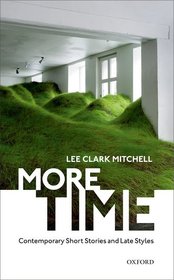
More Time
Contemporary Short Stories and Late Style
- Publisher's listprice GBP 76.00
-
34 314 Ft (32 680 Ft + 5% VAT)
The price is estimated because at the time of ordering we do not know what conversion rates will apply to HUF / product currency when the book arrives. In case HUF is weaker, the price increases slightly, in case HUF is stronger, the price goes lower slightly.
- Discount 10% (cc. 3 431 Ft off)
- Discounted price 30 883 Ft (29 412 Ft + 5% VAT)
Subcribe now and take benefit of a favourable price.
Subscribe
34 314 Ft

Availability
printed on demand
Why don't you give exact delivery time?
Delivery time is estimated on our previous experiences. We give estimations only, because we order from outside Hungary, and the delivery time mainly depends on how quickly the publisher supplies the book. Faster or slower deliveries both happen, but we do our best to supply as quickly as possible.
Product details:
- Publisher OUP Oxford
- Date of Publication 10 April 2019
- ISBN 9780198839224
- Binding Hardback
- No. of pages224 pages
- Size 224x142x18 mm
- Weight 388 g
- Language English 0
Categories
Short description:
More Time traces the careeres of four short story writers, Alice Munro, Andre Dubus, Joy Williams, and Lydia Davis. The focus is on the latter part of these writers careers and how each author has developed and crafted a late style.
MoreLong description:
More Time studies the contemporary short story and focuses on four recent collections: Alice Munro's Dear Life (2012); Andre Dubus's Dancing After Hours (1996); Joy Williams's The Visiting Privilege (2015); and Lydia Davis's Can't and Won't (2014). Each publication has appeared near the conclusion of a career devoted all but exclusively to short stories, with each defining a 'late style' honed over a lifetime. As well, each diverges from others in ways that have profoundly shaped our generic conceptions, and collectively they represent the four most innovative practitioners of the past half-century (with the arguable exception of Raymond Carver).
Yet in an era when writing programs, The New Yorker, and distinguished journals all promulgate the short story, it remains relatively under-examined as a major literary form. We continue to argue about what a story inherently is, ignoring how differences among practitioners enliven the field. Dubus, Munro, Williams, and Davis each defy critical efforts to identify the story form's presumed constitution, marked by a supposedly special shape or requisite length or distinct narrative trajectory. And the very contrast among their efforts reveals the expansiveness of the genre, though few have taken such a cross-glancing interpretive approach. This volume opens up discussion, shifting from close analysis into larger speculation about possibilities established by the most innovative writers in their later work.
Recommended.
Table of Contents:
Introduction: Bulwarks of Silence
Bewilderment in Dear Life
Trauma in Dancing After Hours
Disjointedness in The Visiting Privilege
Less Time in Can't and Won't
Epilogue: Silence and Slow Time
Bibliography

