

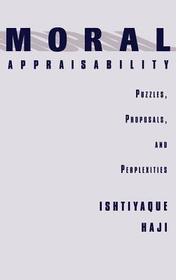
Moral Appraisability
Puzzles, Proposals, and Perplexities
- Publisher's listprice GBP 135.00
-
60 952 Ft (58 050 Ft + 5% VAT)
The price is estimated because at the time of ordering we do not know what conversion rates will apply to HUF / product currency when the book arrives. In case HUF is weaker, the price increases slightly, in case HUF is stronger, the price goes lower slightly.
- Discount 10% (cc. 6 095 Ft off)
- Discounted price 54 857 Ft (52 245 Ft + 5% VAT)
Subcribe now and take benefit of a favourable price.
Subscribe
60 952 Ft

Availability
printed on demand
Why don't you give exact delivery time?
Delivery time is estimated on our previous experiences. We give estimations only, because we order from outside Hungary, and the delivery time mainly depends on how quickly the publisher supplies the book. Faster or slower deliveries both happen, but we do our best to supply as quickly as possible.
Product details:
- Publisher OUP USA
- Date of Publication 20 August 1998
- ISBN 9780195114744
- Binding Hardback
- No. of pages288 pages
- Size 241x165x23 mm
- Weight 581 g
- Language English 0
Categories
Short description:
Professor Haji focuses on a central problem of moral philosophy, that is: whether we are morally responsible for some of our actions, our intentional omissions, or the consequences of these things. His view is that one is morally responsible for performing an action when the following conditions are met: one must control the action in an appropriate way; the action must arise from actional springs (like desires) that are truly the agent's own; and one must act in the belief that one is doing something morally obligatory, right, or wrong. Haji then discusses certain implications of this analysis. He argues that the conditions of moral responsibility he defends are not undermined by determinism and are compatible with varieties of indeterminism.
MoreLong description:
This book explores a central question of moral philosophy, addressing whether we are morally responsible for certain kinds of actions, intentional omissions, and the consequences deriving therefrom.
Haji distinguishes between moral responsibility and a more restrictive category, moral appraisability. To say that a person is appraisable for an action is to say that he or she is deserving either of praise or blame for that action. One of Haji's principal aims is to uncover conditions sufficient for appraisability of actions. He begins with a number of puzzles that serve to structure and organize the issues, each one of which motivates a condition required for appraisability. The core of Haji's analysis involves his examination of three primary types of conditions. According to a control condition, a person must control the action in an appropriate way in order to be appraisable. An autonomy condition permits moral appraisability for an action only if it ultimately derives from a person's authentic evaluative scheme. On Haji's epistemic requirement, moral praiseworthiness or blameworthiness demands belief on the part of the agent in the rightness or wrongness of an action. Haji concludes this portion of his argument by incorporating these conditions into a general principle which outlines sufficient conditions for appraisability.
Haji offers a fascinating discussion of the implications of his analysis. He demonstrates that his appraisability concept is applicable to a variety of non-moral kinds of appraisal, such as those involving legal, prudential and etiquette considerations. He looks at crosscultural attributions of blameworthiness and argues that such attributions are frequently mistaken. He considers the case of addicts and suggests that they may not be morally responsible for actions their addictions are said to cause. He even takes up the intriguing question of whether we can be blamed for the thoughts of our dream selves.
Engaging with a central metaphysical question in his conclusion, Haji argues that the conditions of moral responsibility he defends are neither undermined by determinism nor threatened by certain varieties of incompatibilism.
Addressing a range of little-discussed topics and forging crucial connections between moral theory and moral responsibility, Moral Appraisability is vital reading for students and scholars of moral philosophy, metaphysics, and the philosophy of law.

