

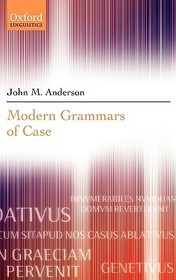
Modern Grammars of Case
- Publisher's listprice GBP 78.00
-
35 217 Ft (33 540 Ft + 5% VAT)
The price is estimated because at the time of ordering we do not know what conversion rates will apply to HUF / product currency when the book arrives. In case HUF is weaker, the price increases slightly, in case HUF is stronger, the price goes lower slightly.
- Discount 10% (cc. 3 522 Ft off)
- Discounted price 31 695 Ft (30 186 Ft + 5% VAT)
Subcribe now and take benefit of a favourable price.
Subscribe
35 217 Ft

Availability
printed on demand
Why don't you give exact delivery time?
Delivery time is estimated on our previous experiences. We give estimations only, because we order from outside Hungary, and the delivery time mainly depends on how quickly the publisher supplies the book. Faster or slower deliveries both happen, but we do our best to supply as quickly as possible.
Product details:
- Publisher OUP Oxford
- Date of Publication 22 June 2006
- ISBN 9780199297078
- Binding Hardback
- No. of pages474 pages
- Size 241x164x30 mm
- Weight 865 g
- Language English 0
Categories
Short description:
This book addresses fundamental issues in linguistic theory, including the relation between formal and cognitive approaches, the autonomy of syntax, and the content of universal grammar. Professor Anderson focuses on the grammar of case relations and, after a critical history of modern grammars of case, explores unresolved issues in the field, including the degree to which syntactic categories are grounded in meaning and the notion of linguistic creativity. He sheds new light on the interactions between meaning and grammar. His argument will interest linguists, philosophers, and cognitive scientists.
MoreLong description:
This book addresses fundamental issues in linguistic theory, including the relation between formal and cognitive approaches, the autonomy of syntax, the content of universal grammar, and the value of generative and functional approaches to grammar. It focuses on the grammar of case relations, signalled by morphological case, prepositions, and word order. Part I offers a critical history of modern grammars of case, focussing on the last four decades and setting this in the context of earlier, including ancient, developments. The subjects considered include the evolution of ideas concerning deep structure and semantic and grammatical relations, and arguments for the maintenance of the traditional central position of case in the grammar. In parts II and III Professor Anderson examines the category of case and central unresolved issues in the grammar of case. The latter include questions relating to the idea of an ontologically-based grammar, particularly the degree to which syntactic categories and relationships are grounded in meaning, and the notion of linguistic creativity. This involves a consideration of the way in which cases may be identified and whether their distribution is determined through semantics. The book sheds new light on the interactions between meaning and grammar and on the structure and development of lexical and grammatical systems. The argument and its far-reaching consequences will be of wide interest to linguists, philosophers and others seeking to understand the workings of language.
MoreTable of Contents:
Prologue
I The Tradition
The Classical Tradition and its Critics
Early Case Grammar
Case Grammar and the Demise of Deep Structure
The Identity of Semantic Relations
Part II The Implementation of the Category of Case
Localist Case Grammar
The Variety of Grammatical Relations
The Category of Case
The Functions of Functors
Part III Case grammar as a Notional Grammar
Groundedness: The Typicality of Case
Argument-Sharing I: Raising
Argument-Sharing II: Control
Epilogue: Case, Notionalism, Creativity, and the Lexicon

